Lawmakers are pressing the Department of Budget and Management (DBM) to finally clear nearly P4 billion in government arrears owed to two major automakers under the Comprehensive Automotive Resurgence Strategy (CARS), a move seen as critical to restoring investor confidence in the Philippines’ industrial policy.
During the bicameral conference committee meeting approving the Department of Trade and Industry’s (DTI) 2026 budget, Senate finance committee chair Sherwin Gatchalian said the release of funds hinges on DBM issuing a Special Allotment Release Order (SARO). The arrears, totaling P3.987 billion, are due to Toyota Motor Philippines Corp. and Mitsubishi Motors Philippines Corp., both long-time participants in the program.
Gatchalian said settling the obligation does not require an immediate cash outlay. Instead, the government only needs to recognize the amount as a budgetary entry, allowing the SARO to be issued and the liability formally covered.
“To make it simple, we invited car manufacturers to participate in CARS, and every time they produce a car, the government shoulders the taxes—income tax, VAT, percentage tax, and other forms of taxes,” Gatchalian said, underscoring the state’s contractual obligation.
Under the approved 2026 DTI budget, the CARS program was allotted P225 million under unprogrammed appropriations. Lawmakers said this allocation should be sufficient for DBM to process the SARO and move toward closing the long-standing arrears.
Established through Executive Order No. 182 in 2015, the CARS program aims to revive local vehicle manufacturing by offering fiscal support in exchange for large-scale production and investments in parts manufacturing. Of the three available slots, Toyota and Mitsubishi took two, committing to produce at least 200,000 units of enrolled models to qualify for incentives of up to P9 billion per model.
House Deputy Speaker Rufus Rodriguez echoed the call for prompt action, noting that both companies have met program requirements and helped keep car prices competitive.
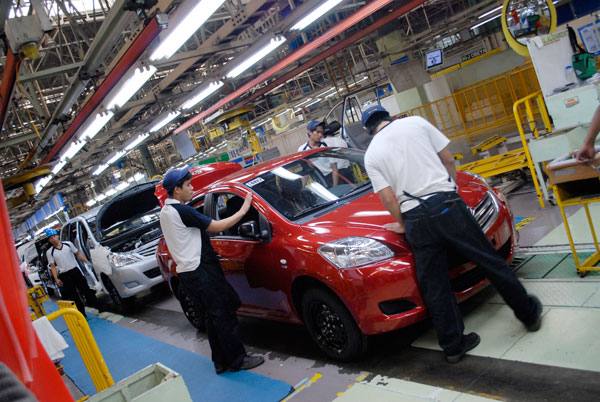
“With the subsidy, they are able to lower the prices of these cars manufactured here,” Rodriguez said, referring to the locally produced Toyota Vios and Mitsubishi Mirage.