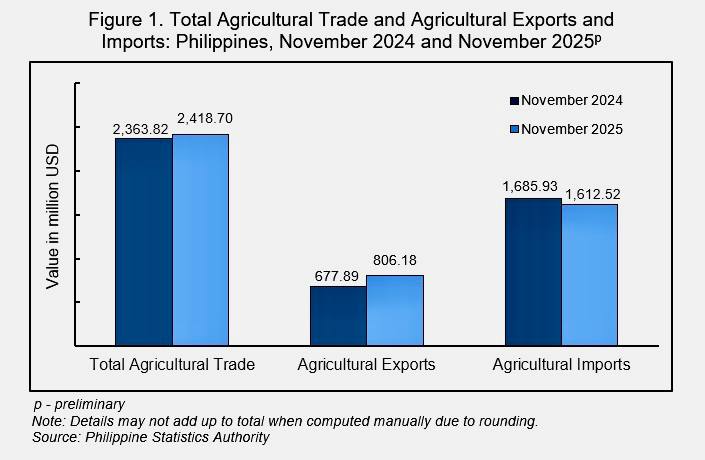
The country’s agricultural trade showed signs of stabilization in November 2025 as a sharp rebound in exports and a decline in imports helped narrow the trade deficit from October levels, even as the gap remained wider than in the same month last year.
Total agricultural trade reached USD2.42 billion in November, posting a 2.3 percent year-on-year increase after contracting in October. The modest expansion, however, fell well short of the 14 percent growth recorded in November 2024, underscoring the uneven and still fragile nature of the sector’s recovery.
Agricultural exports climbed 19 percent to USD806.18 million, accounting for 33 percent of total farm trade and 12 percent of the country’s overall exports. Growth was broad-based but led decisively by animal, vegetable or microbial fats and oils, which generated USD294.37 million and made up 37 percent of export revenues.
The top 10 agricultural commodity groups contributed 98 percent of total export value and grew a combined 19 percent from a year earlier, highlighting the concentration of export earnings.
Imports moved in the opposite direction. Agricultural imports slipped 4.4 percent year on year to USD1.61 billion, representing 16 percent of the country’s total imports. The pullback helped shrink the agricultural trade deficit to USD806.34 million, a 20 percent improvement from November 2024 and narrower than the deficit posted in October, though still sizeable by historical standards.
Europe remained a key export destination. Shipments to the European Union totaled USD227.43 million, with the Netherlands absorbing nearly two-thirds of that amount, largely driven by fats and oils. Within ASEAN, agricultural exports reached USD64.20 million, led by tobacco and nicotine-related products, with Malaysia as the top regional buyer.
On the import side, meat and edible meat offal topped the list at USD225.21 million. Indonesia remained the largest agricultural supplier among ASEAN countries, while Spain led imports from the European Union, reflecting sustained demand for meat, dairy and processed food products.