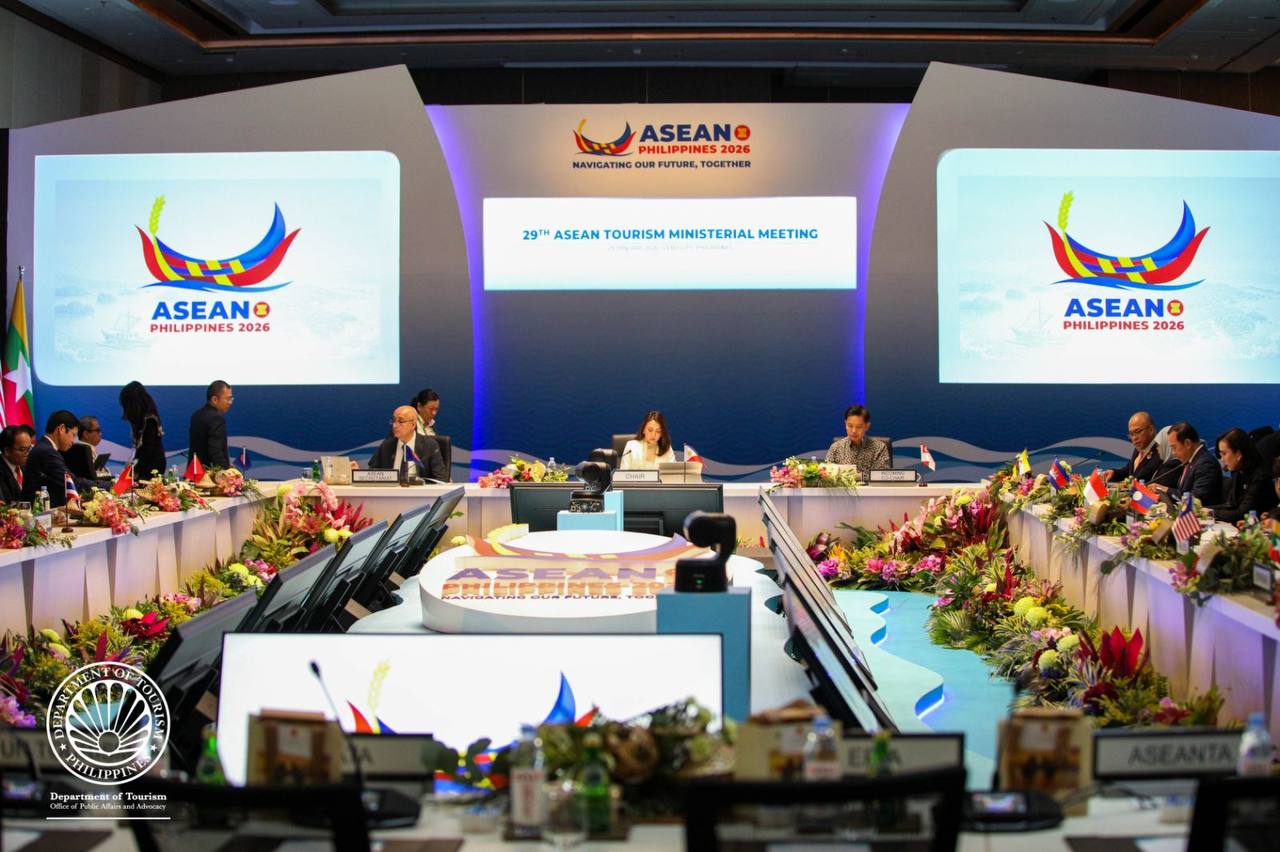
The Philippines has emerged as ASEAN’s top tourism economy, leading the region in tourism’s contribution to gross domestic product and ranking among the strongest job creators, according to the 2025 World Travel and Tourism Council (WTTC) Economic Impact Report.
Presented during the ASEAN Tourism Ministers’ Meeting on Jan. 29 in Cebu, the report showed Philippine tourism generated USD91.8 billion in GDP in 2024, the highest in Southeast Asia. This outpaced Indonesia’s USD71.7 billion, Thailand’s USD67.3 billion, and Singapore’s USD54.6 billion, underscoring the scale of the country’s visitor economy.
Tourism now accounts for 19.9 percent of the Philippine economy, placing it among the region’s most tourism-reliant markets. The data highlight the sector’s central role as a growth driver, a foreign exchange earner, and a stabilizing force for domestic demand.
The employment impact is equally significant. The WTTC estimates the sector supported about 11.22 million jobs nationwide, equivalent to 23 percent of total employment. This represents one of the highest tourism employment shares in ASEAN, exceeded only by Cambodia.
In absolute terms, the Philippines has the region’s second-largest tourism workforce after Indonesia, reinforcing tourism’s importance as a major source of livelihoods for Filipinos across transport, accommodation, food services, and related industries.
The findings position the Philippines as one of ASEAN’s strongest tourism economies, combining high economic value with extensive job generation.
As ASEAN Chair for 2026, the country reaffirmed its commitment to deeper regional cooperation to accelerate tourism growth, expand quality employment, and strengthen Southeast Asia’s competitiveness as a global travel destination.
Industry leaders said sustained infrastructure investment, skills development, and digital transformation will be critical to maintaining momentum amid rising competition, shifting traveler preferences, climate risks, and global economic uncertainty ahead.