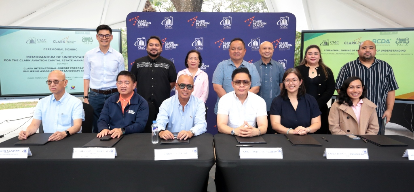
The Clark International Airport Corp. (CIAC) has signed two agreements aimed at protecting heritage, improving food security, and boosting economic growth in Central Luzon and beyond.
The memoranda of understanding were signed on February 24, 2026 at the Clark Aviation Capital Picnic Grounds with the Philippine Association of Landscape Architects (PALA) and South Korea-based Future iNet Co., Ltd. (FIN).
Under its partnership with PALA, CIAC will push forward an Urban Renewal and Heritage Conservation Program. The plan seeks to modernize Clark while preserving its historical and cultural identity. Officials said the program will introduce a unified and sustainable landscaping framework to create greener and more livable public spaces.
Better-designed open areas can help reduce urban heat, improve air quality, manage storm water, and support public health. By protecting Clark’s heritage sites and cultural elements, the project also aims to strengthen local pride and ensure that development does not erase history.
Meanwhile, the agreement with FIN focuses on developing a Cold Chain Bonded Logistics Depot system under the Clark National Food Hub. The project aims to modernize the country’s food logistics network through improved temperature control, customs systems, and inventory management.
An efficient cold chain system is expected to reduce food spoilage, stabilize supply, and maintain food quality from farms to markets. For farmers, this could mean fewer post-harvest losses and better income opportunities. For businesses, it offers faster and more reliable distribution. For consumers, it supports safer food and more stable prices.
CIAC officials said the two partnerships are major steps toward transforming Clark into a global aviation and logistics hub. Beyond infrastructure, the projects are seen as investments in sustainable growth that can attract investors, create jobs, and support industries such as agriculture, logistics, tourism, and urban services.
For Filipinos, the initiatives highlight a development approach that combines modernization with heritage protection, strengthens national food systems, and promotes long-term economic resilience.