Access to clean water is a luxury for many rural and off-grid communities in the Philippines, despite the country being surrounded by seas and blessed with freshwater sources.
Researchers from the Department of Environmental Science at Ateneo de Davao University have brought sunshine to the rescue. Their study, published in the December 2025 issue of the Philippine Journal of Science, presents a low-cost, ultra-portable solar still capable of producing potable water from saline sources using nothing but sunlight and smart design.
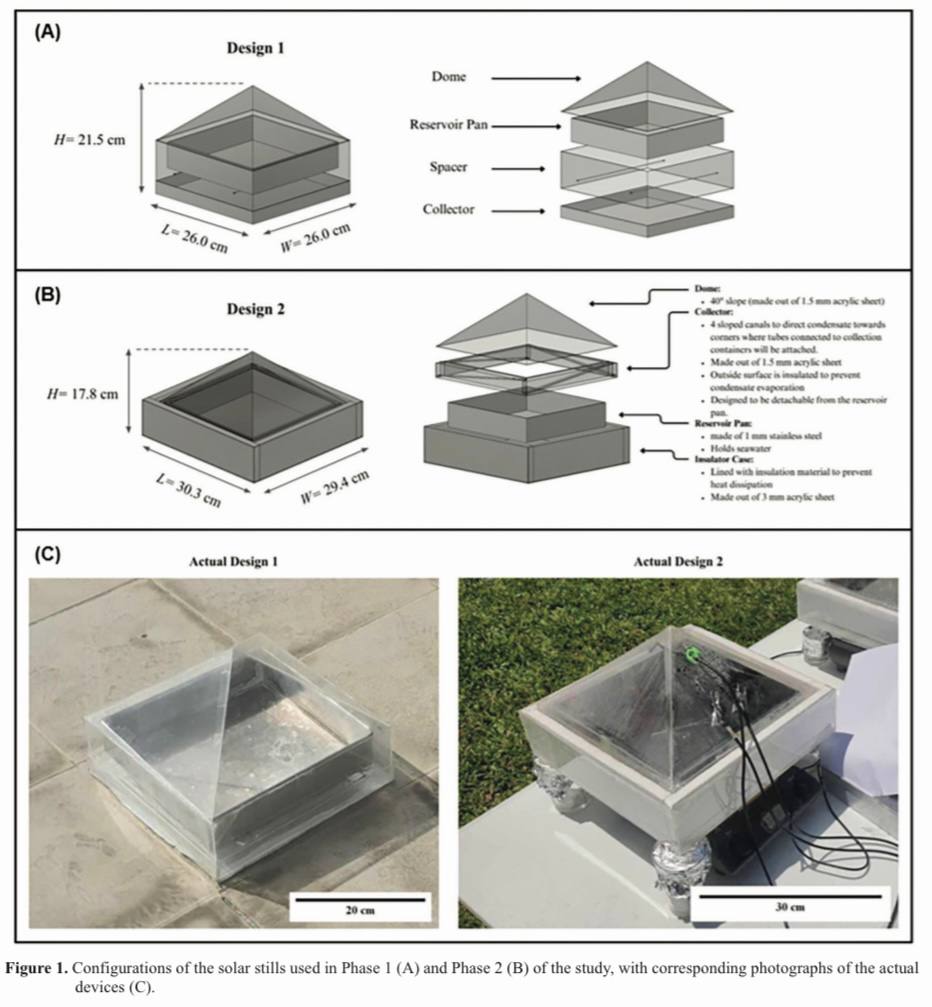
Dubbed a single-stage square pyramidal solar still, the system underwent two phases of testing.
Phase 1 focused on dome inclination angles, revealing that a 40 degree angle desalinated 42.7 percent of 150 mL saline input in just 5–6 hours.
While Phase 1 lacked detailed monitoring, it set the stage for Phase 2, which incorporated external thermal insulation, black-coated reservoirs, and hourly yield tracking. These upgrades dramatically increased productivity, with insulated units producing up to 2.4 liters per square meter per day, compared to less than 0.7 liters for the non-insulated setup.
At just P3,500 to fabricate and weighing only 3.3 kilograms, the prototype is designed to be carried and deployed with ease. Cost estimates suggest water production could run as low as P0.86 per liter, making the device both affordable and practical for households in remote or disaster-prone areas.
According to the researchers, dome geometry, solar incidence, and internal vapor volume interact to influence performance, while insulation enhances thermal retention and yield.
Every liter counts when you are miles from a clean tap. The solar still can turn sunlight into a reliable freshwater source, helping rural communities adapt to water scarcity and climate challenges.
The study also notes limitations. It noted that the system was tested on a synthetic 3.5 percent saline solution at only two sites, and long-term durability, scalability, and water-quality outcomes remain untested.
Still, these findings underscore the promise of portable, low-energy desalination as a tool for water security in tropical, off-grid settings.
By optimizing dome angles, insulation, and materials, solar-powered stills like this one could transform the way vulnerable communities access freshwater, one sun-soaked drop at a time.