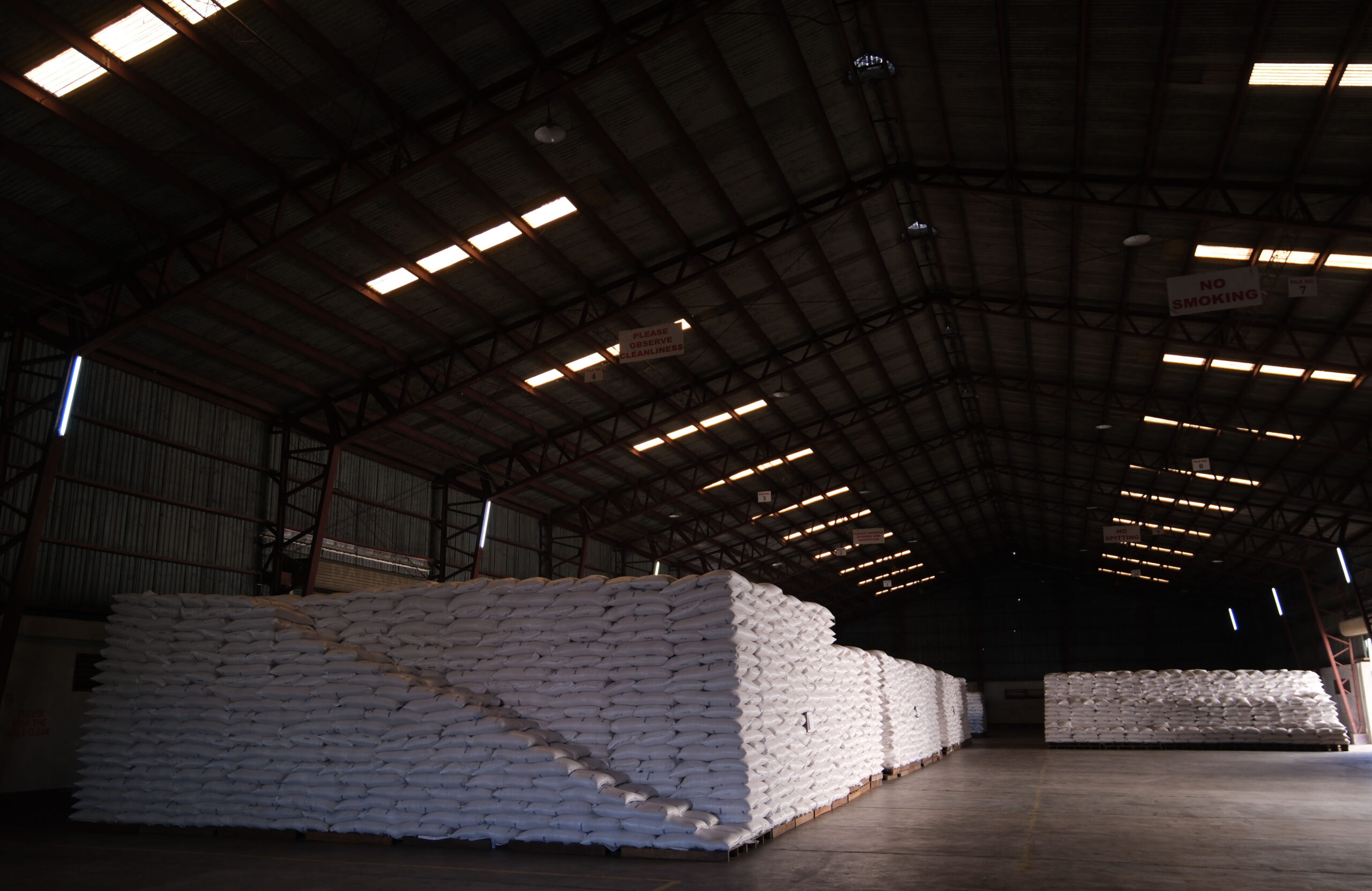
The National Food Authority (NFA) is turning up the heat on inefficiency—by cooling it down.
In Pili, Camarines Sur, the agency has begun upgrading a major warehouse facility in a move officials say will strengthen the country’s rice buffer stock system while directly protecting farmers’ livelihoods.
At the core of the modernization is an automated ventilation system engineered to maintain optimal storage conditions for palay. Microcomputer control units with built-in processors and LoRa connectivity collect temperature and humidity data every five minutes from wireless sensors installed in heat-prone sections of the warehouse.
When the hourly average temperature just reach a certain degree, industrial exhaust blowers switch on automatically. Each ventilation unit can move up to 10,000 cubic meters of air per hour—enough to clear accumulated heat from a space equivalent to two full-sized school gymnasiums within an hour. The system doesn’t require manual switching, prevents delayed intervention, and ensures a continuous, data-driven airflow management.
The ventilation system carries an estimated cost of P1.21 million in the Camarines Sur area.
Powering the upgrade is a 16-kilowatt solar generating system composed of 32 high-capacity panels, a three-phase hybrid inverter, and five 15KWh batteries. At full load, the warehouse consumes around 12KW—roughly 75 percent of rated capacity—sufficient to operate exhaust motors, lighting systems, office equipment and air-conditioning units.
The solar component represents an additional P1.40 million investment, underscoring NFA’s push for energy resilience and lower operating expenses.
Thermal protection extends overhead. Insulation options offer R-values, which represents the insulation material’s resistance to heat, reducing heat transfer from the roof to the grain stacks below. For a duplex warehouse with a 200,000-cavan design capacity and floor area equivalent to about nine standard basketball courts, temperature stability is critical to preventing moisture buildup and quality deterioration.
Insulation costs range from P3.26 million to P3.70 million.
NFA Administrator Larry Lacson said the investment is fundamentally about farmer protection.
“This upgrade is about protecting the hard work of our rice farmers,” Lacson said. “By improving storage conditions, we reduce post-harvest losses, preserve grain quality, and make sure the palay we procure retains its value. That strengthens recipient confidence and ensures farmers are properly supported.”
Agriculture Secretary Francisco P. Tiu Laurel Jr., who chairs the NFA Council, framed the project within the Marcos administration’s broader reform agenda.
“This modernization effort reflects our commitment to transform Philippine agriculture,” Tiu Laurel said. “By investing in better storage, renewable energy, and smarter systems, we are improving farmers’ incomes, reducing waste, and reinforcing food security for every Filipino family.”
The Camarines Sur branch is coordinating with Central Bicol State University to further validate and refine the system’s performance.
As climate risks intensify and supply chains tighten, the message from Pili is unmistakable: food security does not end at harvest. It depends on what technology is adopted inside the warehouse.