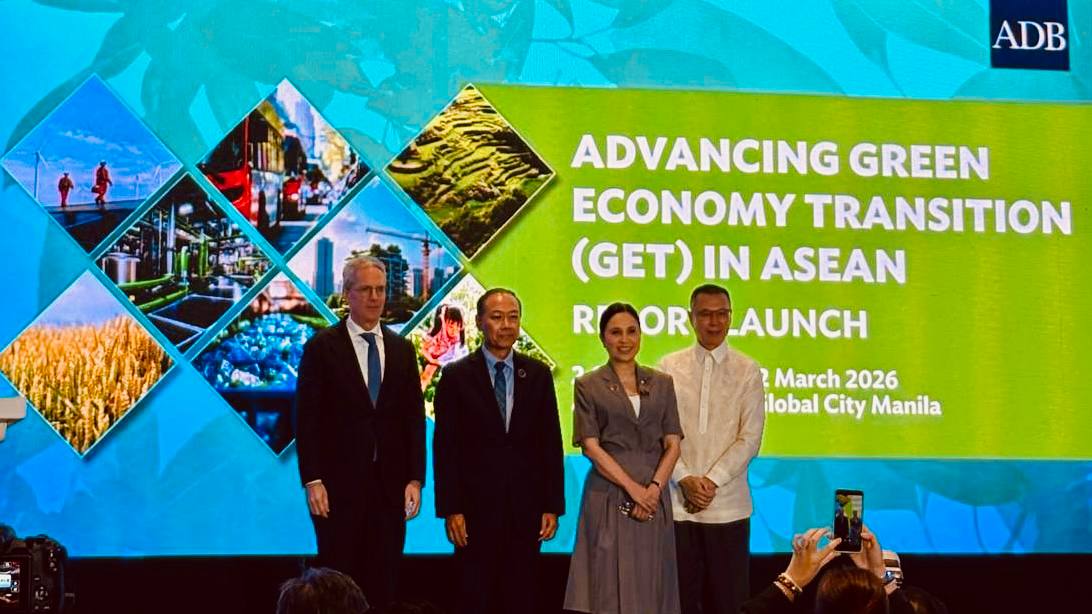
Rising geopolitical tensions in the Middle East may unintentionally accelerate Southeast Asia’s shift toward renewable energy, as governments confront the economic risks of heavy dependence on imported fossil fuels.
Trade and Industry Secretary Cristina Roque said the ongoing crisis underscores the urgency for the region to diversify its energy mix.
Speaking Thursday at the launch of the Advancing Green Economy Transition in ASEAN report in Taguig City, Roque said volatile oil markets linked to geopolitical conflict could push policymakers and investors to move faster toward renewable energy.
“Renewable energy will be accelerated now because of the crisis,” Roque said, noting that Southeast Asian economies remain exposed to sudden price spikes and supply disruptions due to their reliance on imported fuel.
At the same event, Scott Morris of the Asian Development Bank warned that despite efforts to cushion fuel price shocks, ASEAN’s current energy structure leaves the region vulnerable during global disruptions.
Morris said the green transition presents not just a climate solution but a significant economic opportunity. A robust green economy across Asia could generate as much as USD1 trillion in annual revenue and create up to 30 million jobs, he said, while strengthening the region’s competitiveness as global markets increasingly favor low-carbon production.
However, he stressed that public funding alone will not be enough to drive the transformation. Governments must pair policy support and incentives with stronger private-sector participation to finance renewable infrastructure, modernize industrial systems, and expand green employment.
Roque said the Philippines is positioning itself as a regional driver of the transition through its leadership of ASEAN task forces on carbon neutrality and the blue economy.
The administration of President Ferdinand Marcos Jr. sees sustainability as a new engine for investment and growth, Roque added, with deeper regional cooperation expected to play a key role in accelerating Southeast Asia’s green energy shift.