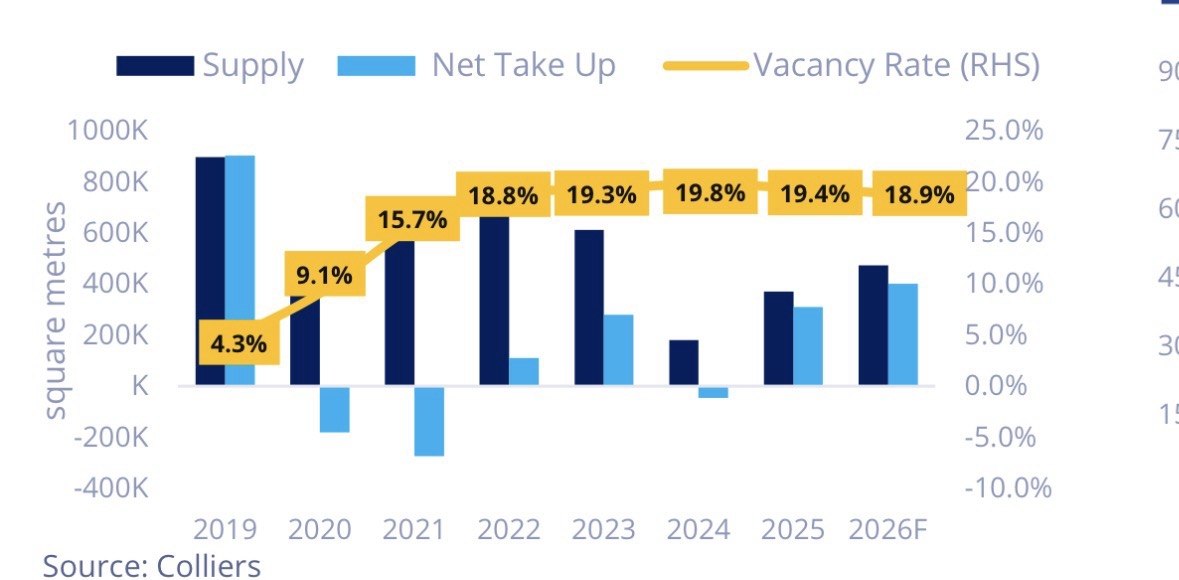
A new survey highlighted by Colliers Philippines points to changing preferences across the country’s office, residential, hotel, and industrial sectors, as evolving consumer behavior reshapes real estate strategies.
In the office market, respondents favor malls as ideal sites for flexible workspaces, with cafés, condominiums, and hotels also gaining traction.
Colliers said transit-oriented malls offer strong potential due to steady foot traffic and integrated mixed-use environments, prompting developers to consider unconventional co-working locations.
Outside major CBDs, Makati Fringe and Quezon City remain preferred expansion hubs, combining lower rents with access to transport and nearby residential communities.
Residential property remains a buyers’ market, with about 29,400 unsold ready-for-occupancy units in Metro Manila as of end-2025.
Developers are responding with steeper discounts, flexible payment terms, and rent-to-own schemes, lifting demand in the mid-income segment. Buyers are gravitating toward high-inventory areas such as Quezon City, Cubao–New Manila, Pasig, Manila, the Bay Area, and Alabang–Las Piñas.
Tourism continues to buoy the hotel segment, led by domestic destinations such as Palawan and Boracay, followed by Siargao and Cebu. Abroad, Taipei emerged as a top choice for budget-conscious travelers. Colliers sees room for bundled airline deals and strategic pricing, while staycation demand remains centered in Fort Bonifacio, the Bay Area, and Makati CBD.
In industrial real estate, e-commerce demand continues to accelerate the need for logistics facilities. Frequent online purchases—ranging from food to electronics—are driving requirements for warehouses and cold storage. With nearly two-thirds of respondents willing to pay more for same-day delivery, developers are being pushed to modernize assets with higher power capacity and tech-ready infrastructure.
Despite policy rate cuts by the Bangko Sentral ng Pilipinas, mortgage rates remain elevated, prompting developers to roll out more flexible financing schemes.
Colliers expects further rate easing to support retail and leisure spending, bolstering recurring income from malls, hotels, and mixed-use developments.