The Philippines is expected to sustain steady economic growth through 2027 despite fallout from the Iran conflict, though inflation could rise toward the upper end of the government’s 2–4 percent target, the ASEAN+3 Macroeconomic Research Office said.
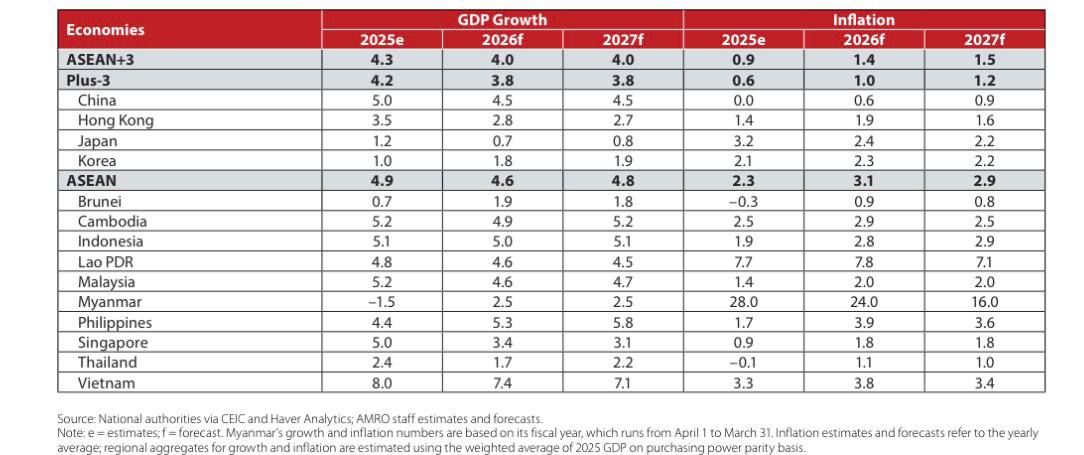
AMRO projected in a virtual briefing that the Philippine gross domestic product (GDP) to grow by 5.3 percent in 2026, unchanged from its January forecast and higher than the estimated 4.4 percent in 2025. Growth is seen accelerating further to 5.5 percent in 2027.
“Had the Iran conflict not occurred, growth could have been higher in the case of the Philippines,” said Allen Ng, group head at chief economist at AMRO, noting that the outlook reflects strong pre-conflict momentum driven by domestic demand.
Inflation, however, is expected to climb from 1.7 percent in 2025 to 3.9 percent in 2026 before easing to 3.6 percent in 2027—near the ceiling of the central bank’s target range.
Yasuto Watanabe said the Philippines’ heavy reliance on Middle Eastern oil imports could add to price pressures, potentially constraining policy.
The country sources about 98 percent of its oil from the region, making it among the most exposed economies.
Inflation is also projected to exceed the regional average of 3.1 percent in 2026 and 2.9 percent in 2027. “Our baseline is for inflation to trend higher… not double digits,” Ng said, while warning that risks remain tilted upward if oil prices spike or supply disruptions persist.
He added that policymakers must prevent supply shocks from triggering broader price pressures, requiring cautious monetary policy and targeted fiscal support for vulnerable sectors.
Despite external risks, the Philippines is expected to remain one of ASEAN’s faster-growing economies. Its 2026 growth outlook places it behind Vietnam’s projected 7.4 percent expansion but above the regional average of 4.6 percent.
Across ASEAN, growth is forecast to moderate to 4.6 percent in 2026 before edging up to 4.8 percent in 2027, supported partly by domestic demand and investment.
For the broader ASEAN+3 region, growth is projected to slow to 4 percent in 2026 and 2027 from 4.3 percent in 2025, while inflation is seen rising modestly to 1.4–1.5 percent.
AMRO said the outlook remains uncertain, with risks tilted to the downside amid ongoing geopolitical tensions and external headwinds.