The Philippines’ push toward a higher credit rating has been put on hold as global risks cloud the near-term outlook, even as underlying economic fundamentals remain intact.
S&P Global Ratings on April 8 affirmed the country’s ‘BBB+’ long-term sovereign rating and ‘A-2’ short-term rating, while revising the outlook to stable from positive. The move signals a pause in upgrade expectations that had been building since November 2024, when the agency first assigned a positive outlook.
A positive outlook typically indicates a possible rating upgrade within 12 to 24 months. By shifting to a stable outlook, S&P has removed that upward bias, suggesting that any rating action, whether an upgrade or downgrade, could take place within a broader 6 to 24 month window. In effect, the change delays what had been seen as a strong chance of a near-term upgrade.
The revision was driven largely by rising external risks, particularly geopolitical tensions in the Middle East that have pushed global oil prices higher. For the Philippines, which relies on energy imports, this is expected to widen the current account deficit and weaken a key external buffer in the near term.
Despite this, S&P emphasized that the outlook change does not reflect a deterioration in domestic economic conditions. Instead, it reflects heightened uncertainty in the global environment.
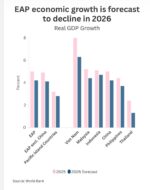
Economic growth slowed to 4.4 percent in 2025 from an average of 6.3 percent in the previous three years, mainly due to a temporary reduction in public infrastructure spending following investigations into flood-control projects. The ratings agency expects growth to rebound to 5.8 percent in 2026 as the impact of both the spending slowdown and higher energy costs begins to ease.
Over the medium term, gross domestic product is projected to expand by an average of 6.2 percent from 2027 to 2029, supported by strong household consumption, steady remittances from overseas Filipinos, and continued investment.
Inflation, which fell to 1.7 percent in 2025, is expected to rise to about 3.4 percent in 2026 due to higher energy prices before settling at around 3 percent in the following years.
On the fiscal side, S&P expects the government deficit to gradually narrow to an average of 2.9 percent of GDP over the next three years, while net public debt is projected to decline to about 42.5 percent of GDP by 2029.
The outlook shift carries implications for government financing. A higher credit rating would typically lower borrowing costs, a key consideration for a government running a sizable budget deficit. With the upgrade now delayed, the Philippines may not immediately benefit from cheaper financing that could have supported spending on infrastructure and social programs.
Externally, the current account deficit is forecast to widen to 4 percent of GDP in 2026 from 3.3 percent in 2025, largely due to higher energy import costs. Even so, the country’s external position remains supported by strong remittances and foreign exchange reserves, which stood at USD107.5 billion as of March 2026.
S&P said the stable outlook reflects its expectation that the Philippines will sustain solid economic growth while gradually improving fiscal balances over the next two years, even as external indicators soften.
For now, the country’s investment-grade rating remains intact, but the path to an upgrade has become less certain as global risks take center stage.