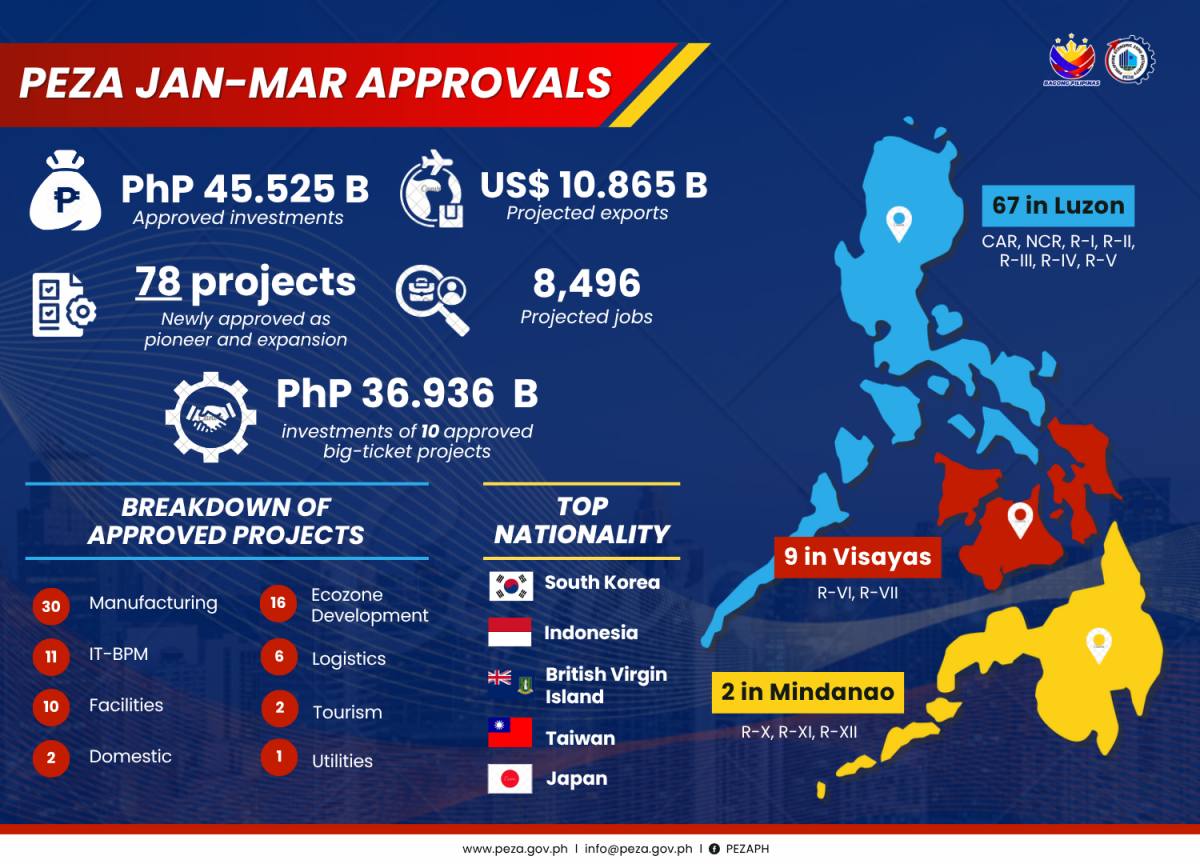
Approved investments by the Philippine Economic Zone Authority (PEZA) fell 23 percent in the first quarter to P45.53 billion, down from P58.95 billion a year earlier, as global uncertainties tempered capital commitments.
Despite the decline, PEZA Director-General Tereso Panga said the agency remains on track to meet its full-year investment target of P300 billion, although it is prepared to recalibrate expectations if external risks intensify.
“We are still confident that we will be able to meet our targets for this year based on our current assessment,” Panga said, noting that prolonged tensions in the Middle East could prompt global firms to reassess investment plans. “We are ready for this and we expect it before it even happens.”
PEZA approved 78 new and expansion projects in the first quarter, up 18 percent from 66 projects a year ago, signaling sustained investor interest despite lower aggregate values.
These projects are projected to generate USD10.87 billion in exports and 8,496 direct jobs, indicating a continued shift toward export-oriented and higher-value activities.
Panga said the investment mix reflects a transition toward more sophisticated operations within economic zones. While overall investment levels show a more measured pace, strong export projections suggest rising interest in high-value industries.
Manufacturing led approvals with 30 projects, followed by ecozone development (16), IT-BPM (11), facilities (10), logistics (6), tourism (2), and utilities (1). The majority of projects were located in Luzon (67), with nine in the Visayas and two in Mindanao, in line with efforts to promote more balanced regional development.
Investor participation was
dominated by firms from Taiwan, the US, India, Japan, and Hong Kong. Ten large-scale projects worth over P36 billion anchored first-quarter performance, highlighting a preference for investments aligned with global supply chains.
In March alone, the PEZA board cleared 26 projects valued at P10.16 billion, expected to generate USD422.7 million in exports and 3,447 jobs, including ventures in ecozone development, renewable energy, aviation services, and facilities management.