Philippine export sales at the 8th China International Import Expo (CIIE) cooled to USD269 million, reflecting softer headline numbers but steady underlying demand from Chinese buyers for Filipino food and agricultural products.
Nineteen export-ready companies joined the month-long showcase at Shanghai’s National Exhibition and Convention Center, logging sales far below the USD1.212 billion in 2024 and USD1.102 billion in 2023.
Trade officials stressed the decline was expected, pointing to tighter customs compliance and temporary supply constraints—most notably durian—that curbed outsized deals seen in prior years.
The Center for International Trade Expositions and Missions (CITEM) said previous billion-dollar results were largely driven by extraordinary durian demand that outstripped Philippine production capacity.
“It will take years to fully meet China’s real demand,” said Trade Vice Consul Jose Ma. Dinsay, adding that this year marked a strategic recalibration toward a broader product mix.
That shift showed results. Buyer interest expanded beyond durian to coconut products, bananas, muscovado sugar, and eel, with inquiries rising from last year.
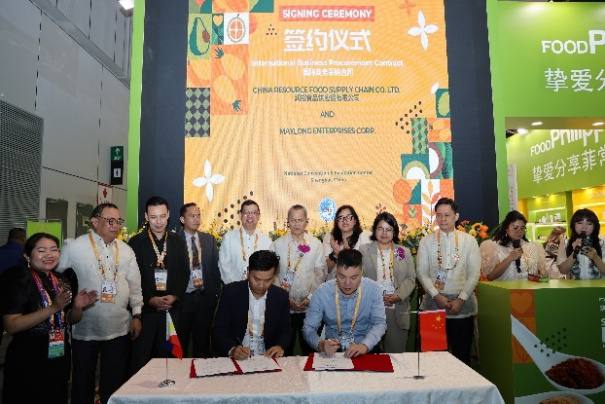
Several supply agreements were sealed, including a two-million-kilogram fresh durian deal between Fruta Asiatica Export and Agri-Trading and Weihai Pure Fruit Food Technology Co., Ltd., and a 200-ton coconut oil contract between Shanghai Nam Chow Foods and New Asia Oil Inc. Additional agreements covered young coconuts, fresh and frozen durian, and eel.
Despite a new pavilion location, the Philippine showcase generated 547 trade inquiries—nearly double the target—and attracted the same number of buyers, the strongest turnout in five years. Backed by CITEM and the Department of Agriculture’s Halal Food Industry Development Program, the pavilion highlighted products aligned with China’s appetite for healthy, organic, and functional foods, while also drawing interest from buyers in the UK, Italy, Singapore, and Saudi Arabia.