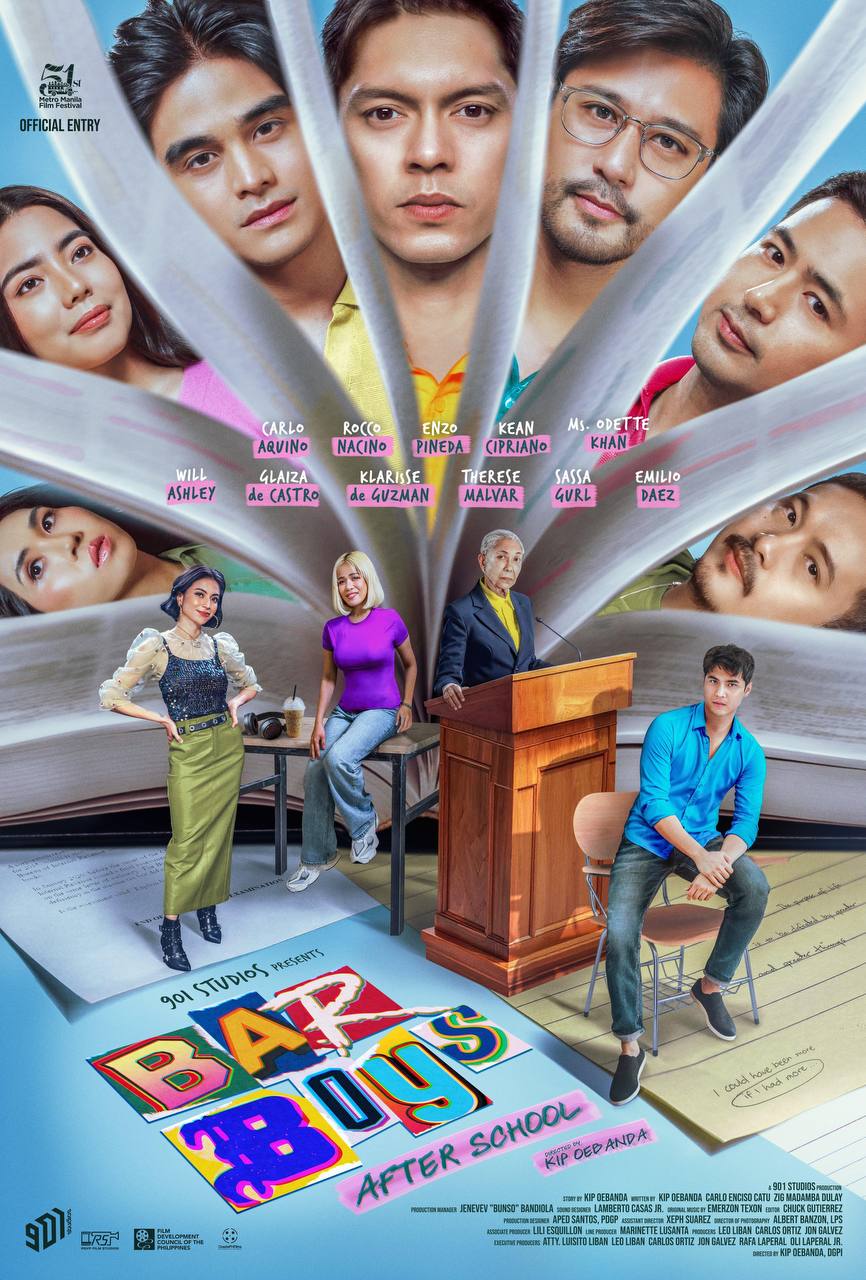
Life loves to murder your dreams—but petty as she is, she also leaves the door ajar, daring you to crawl back in. “Bar Boys: After School” kicks that door wide open and asks what happens after the bar exams, after the victories, after the idealism wears thin, and adulthood starts charging interest.
A decade after the original “Bar Boys” (2017), director and screenwriter Kip Oebanda reunites Torran Garcia (Rocco Nacino), Erik Vicencio (Carlo Aquino), Chris Carlson (Enzo Pineda), and Josh Zuniga (Kean Cipriano), now older, wearier, and carrying the emotional equivalent of student loans.
The barkada is scattered across careers and compromises—until news arrives that their formidable law school mentor, Justice Hernandez (Odette Khan, quietly magnetic), is terminally ill. One last homage pulls them back together, and with it, the lives they thought they had neatly filed away.
Each man is forced to cross-examine his own choices.
Erik, now a human rights lawyer, is haunted by the assassination of a client he couldn’t save. Chris enjoys success as a New York barrister, but it came at the cost of his family life. Torran, stuck in corporate law, realizes his heart never left the classroom. And Josh, once an actor chasing applause, is now chasing a law dream everyone—including himself—thought had expired. Their struggles are not melodramatic flourishes but quiet, familiar failures that sting precisely because they feel true.
Threaded into their reunion is a new generation of law students—bright, burdened, and brimming with unresolved ghosts. As Torran takes over Justice Hernandez’s political law class, past and future collide, forming a loose fraternity of bruised idealists learning that purpose rarely arrives on schedule.
Justice Hernandez herself emerges as the film’s emotional spine. Stern, incisive, yet unexpectedly playful, she reveals a wicked sense of humor beneath the gavel. In one memorable moment, she teases class valedictorian Trish Perez (Sassa Gurl) in mock disapproval, remarking that she doesn’t approve of the dress Trish wore because it failed to match her skin tone—a gentle jab that lands as affection rather than cruelty.
Later, in one of the film’s most affecting turns, Hernandez confesses that she chose career over family—a decision she owns without apology, but not without cost. Stripped of her robe and reputation, she asks to be called “Bing,” a name that softens the myth into a woman nearing the end, reckoning with what remains. When chemotherapy takes her hair, she answers with a wig worthy of a 1960s bombshell, a decade she remembers fondly—proof that even in loss, she refuses to let life dictate the final look.
Her wake becomes the film’s quiet triumph: clients she defended and served for decades arrive in droves, placards in tow, to pay their respects. In that gathering, it becomes clear that this, too, is family—one forged not by blood, but by justice, service, and shared survival.
What Bar Boys: After School lacks in polish and production muscle, it compensates for with heart and a script that understands the Filipino condition: work hard, fall short, and try again anyway. That sincerity likely earned it the FPJ Memorial Award, recognizing its themes of struggle, hope, and social justice—values deeply woven into the national psyche.
Khan won the award for Best Supporting Actress, an award that stands as a quiet benediction for the 79-year-old performer who has said that, in the end, she wanted nothing else from life but the chance to be an actress.
Justice Hernandez, strict yet slyly humorous—evoking the spirit of Miriam Defensor-Santiago—delivers the film’s thesis with disarming simplicity: “Maybe the point of life is not to win or lose, but to experience life.”
In Bar Boys: After School, dreams may die, but the do-over is always waiting.