The World Trade Organization (WTO) has urged the Philippines to sharpen its focus on digitally delivered services and climate resilience as twin engines for growth, competitiveness, and job creation, as global trade dynamics continue to shift rapidly.
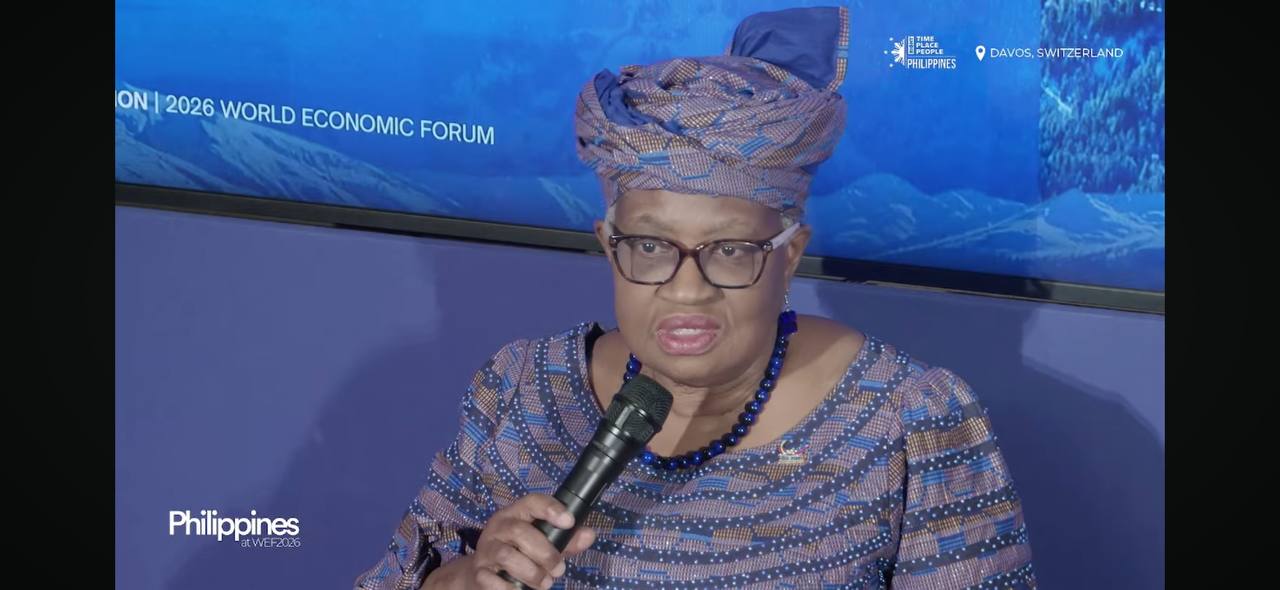
Speaking at the Philippine Pavilion during the World Economic Forum Annual Meeting in Davos on January 20, WTO Director-General Ngozi Okonjo-Iweala said global services trade remains a bright spot in the world economy. Services trade grew by nearly 4.5 percent last year, outpacing goods trade, which expanded by just 2.4 percent and is projected to slow to around 0.5 percent.
Within services, digitally delivered trade—services supplied across computer networks—is growing even faster, at close to 6 percent annually. Okonjo-Iweala said this presents a major opportunity for countries with the right skills base and digital infrastructure.
“The Philippines has quite a lot going for it,” she said, pointing to the country’s well-established business process outsourcing (BPO) sector as a solid foundation. She encouraged the Philippines to move further into AI-enabled services, noting their potential to raise productivity and create higher-value jobs, provided investments in skills development and training keep pace.
According to Okonjo-Iweala, digitally delivered services offer the Philippines both a competitive and comparative advantage, especially as global demand accelerates and competition intensifies.
At the same time, she warned that climate vulnerability remains a major structural risk to growth. As one of the world’s most disaster-prone countries, the Philippines regularly absorbs economic shocks from typhoons, floods, and other extreme weather events, which repeatedly dent GDP and disrupt development.
To address this, she stressed the importance of sustained investment in climate-proofing and adaptation. Done well, she said, climate action can protect the economy while also generating jobs through adaptation and mitigation projects.
Taken together, the WTO’s message outlines a clear dual strategy: harness digital transformation—particularly AI-enabled services—while embedding climate resilience into long-term economic planning.
Pursued in parallel, these priorities could help the Philippines strengthen growth, create quality employment, and better withstand global and environmental shocks.