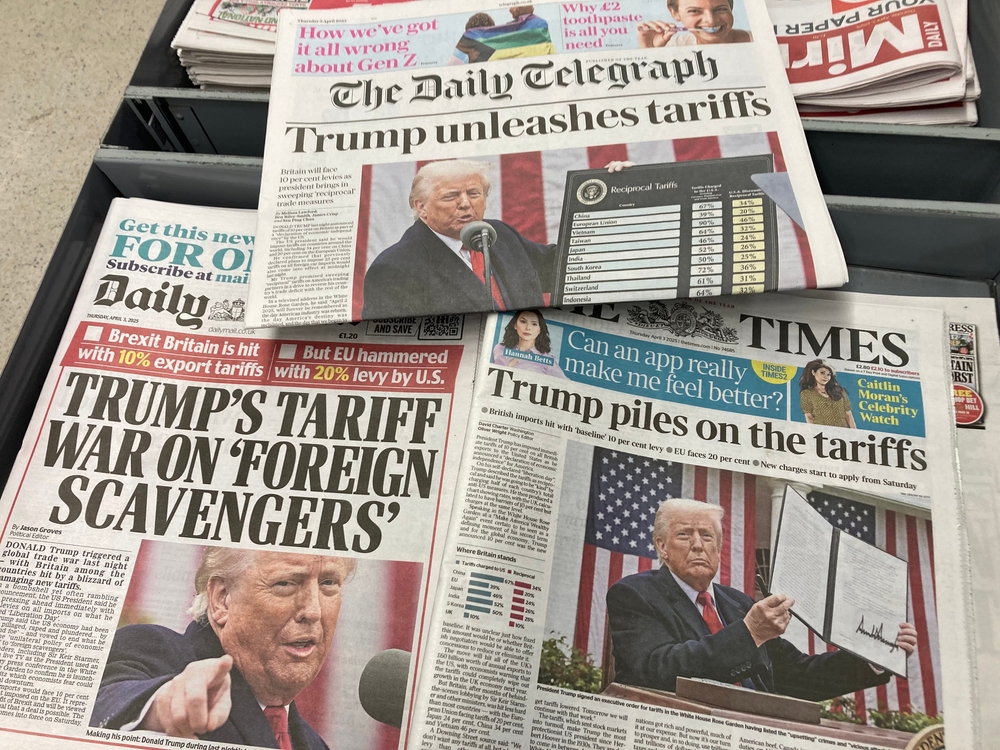
The US Supreme Court on Friday struck down the sweeping global tariffs imposed last year by President Donald Trump, delivering a body blow to a central pillar of his economic agenda.
Voting 6-3, the high court declared unconstitutional the global tariffs Trump imposed under an emergency powers law, saying the president overstepped his authority by unilaterally setting broad-based import taxes. The decision voids the so-called “Liberation Day” tariffs announced on April 2, but does not cover separate, product-specific or country-specific duties still in place.
“The Framers did not vest any part of the taxing power in the Executive Branch,” Chief Justice John Roberts wrote for the majority, emphasizing that the Constitution grants Congress—not the president—the authority to levy taxes.
The now-invalidated tariffs had imposed a blanket 10 percent duty on all countries, with steeper rates for major trading partners, including 54 percent on China, 24 percent on Japan, and 25 percent on South Korea.
The measures jolted global markets and strained ties with allies, while critics derided the formula used to compute the tariffs as arbitrary and economically unsound.
The ruling lands at a delicate moment. Trump is scheduled to visit China in April for talks expected to focus heavily on trade, placing fresh uncertainty over the administration’s negotiating leverage with the world’s second-largest economy.
Markets are likely to react swiftly as investors reassess supply chains, pricing, and the broader trajectory of US trade policy.