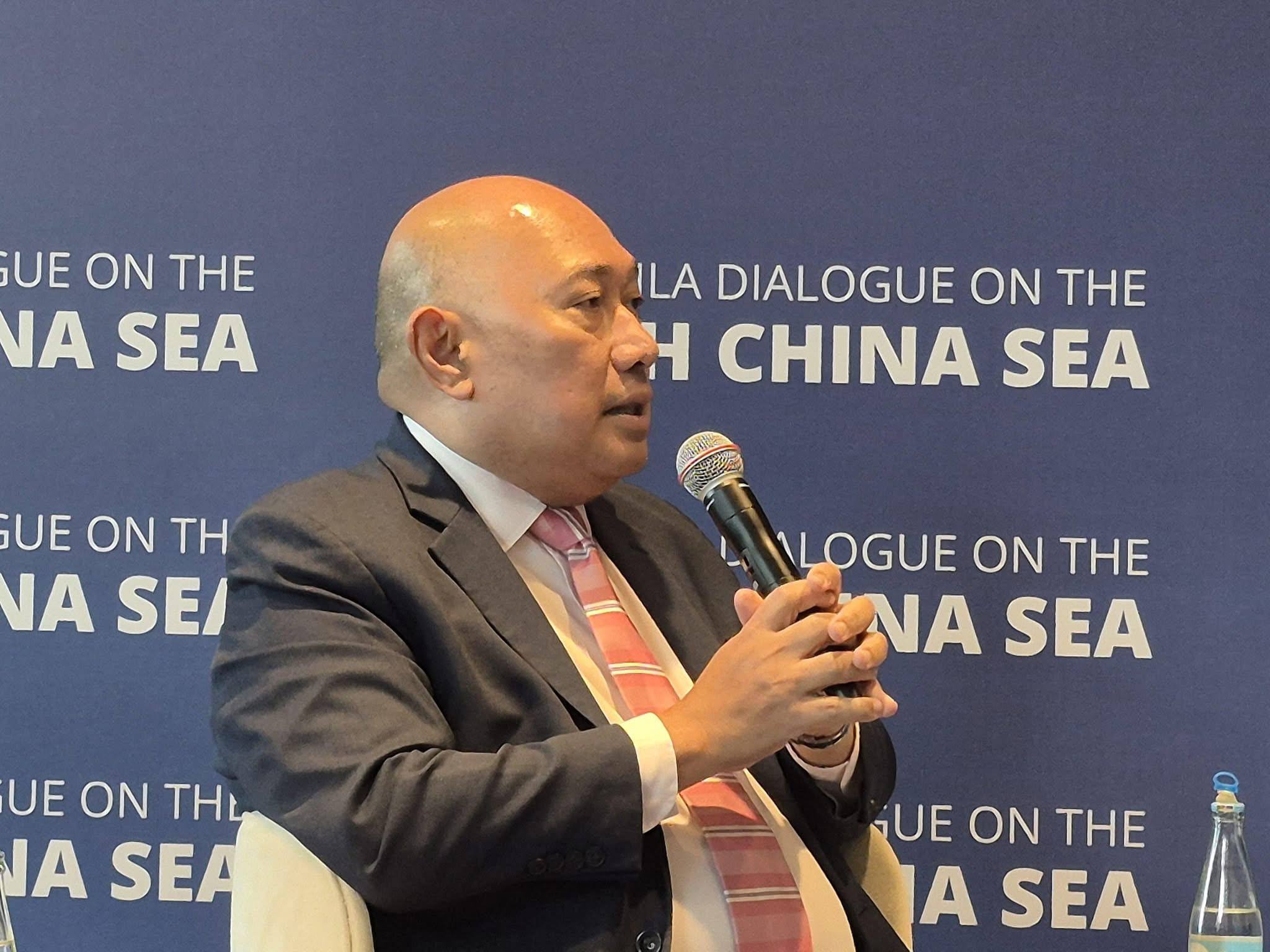
Cooperation between the Philippines and Japan was no longer a choice “but a requirement,” government leaders and experts said on Tuesday, as both countries marked the 70th anniversary of the normalization of their diplomatic relations amid rising tensions both in the Indo-Pacific and the Middle East.
In a high-level conference organized by Stratbase Institute and the Embassy of Japan to the Philippines, experts led by Stratbase President and CEO Victor Andres “Dindo” Manhit stressed that the current geopolitical climate was “not a normal moment” and demanded stronger, more decisive partnerships especially between trusted countries.
These ties, he said, now carried greater strategic importance, particularly in strengthening supply chains and reducing vulnerabilities in an increasingly uncertain global environment.
“In a region where the stakes continue to rise, the Philippines and Japan have both the opportunity and the responsibility to work together—to strengthen economic resilience, enhance security cooperation, and uphold the principles that keep our region stable and open,” Manhit said in his opening remarks.
“This is not a normal moment,” he added. “The rules that have long kept our region stable are being tested, tensions are rising, and supply chains remain vulnerable.”
Against this backdrop, Manhit said, both countries must evolve beyond tradition and deliver concrete outcomes particularly in economic resilience and security cooperation.
Diplomatic relations between Tokyo and Manila were normalized on July 23, 1956, following a post-World War II reconciliation forged under former President Elpidio Quirino. The two countries’ bilateral relations have since evolved into a key pillar for stability in the Indo-Pacific region.
Ambassador of Japan to the Philippines H.E. Endo Kazuya characterized the two countries’ relationship as entering a “golden age” as cooperation is “deepening and extending steadily across all fields.”
He added that the two countries’ bilateral ties could even serve as a model for other nations as “benevolence and long-term perspective have paved the way for genuine reconciliation and seven decades of friendship.”
“As maritime nations located along significant sea lanes in a close neighborhood, both allied with the United States, and facing similar challenges against maritime order, our security cooperation is a natural necessity,” he said.
The diplomat also noted that Japan remained the Philippines’ top source of official development assistance (ODA), which has funded several critical infrastructure projects over the years.
The partnership has also expanded into defense, with Japan emerging as a key security partner as maritime challenges escalate. This includes, among others, the signing of the Reciprocal Access Agreement (RAA) in 2024, which facilitates joint training and the deployment of troops.
Trilateral cooperation among the Philippines-Japan-United States, and the quadrilateral cooperation among the Philippines-Japan-the U.S.-Australia “are both growing,” Endo said, adding that he anticipated “strengthened participation of the Japan Self-Defense Forces in upcoming Balikatan exercises held in the Philippines.”
He added that he was seeing “new possibilities emerging in Japan–Philippines relations,” including “promising horizons for cooperation in fields such as space, green transformation (GX), digital transformation (DX), and artificial intelligence (AI).”
Finance Secretary Frederick Go, in his keynote speech, likewise said the Philippine government “remains fully committed to further strengthening our strategic partnership with Japan.”
He noted that this relationship has evolved from mere economic partnership into “like-minded nations working together to advance stability, resilience, and opportunity in our region.”
Former associate justice Antonio Carpio, meanwhile, highlighted the importance of the Philippine-Japan relations in maintaining rules-based order in the Indo-Pacific particularly in the disputed West Philippine Sea.
“What will happen five to 10 years from now in the South China Sea depends on what we do today. Our objective is to ensure that the rule-space order applies to the South China Sea,” Carpio said. “That would mean the UNCLOS would apply to the South China Sea. Our objective should be to strengthen the arbitral award so the world can rally behind it.”