Filipino families are getting smaller, and no, it is not because storks filed for early retirement.
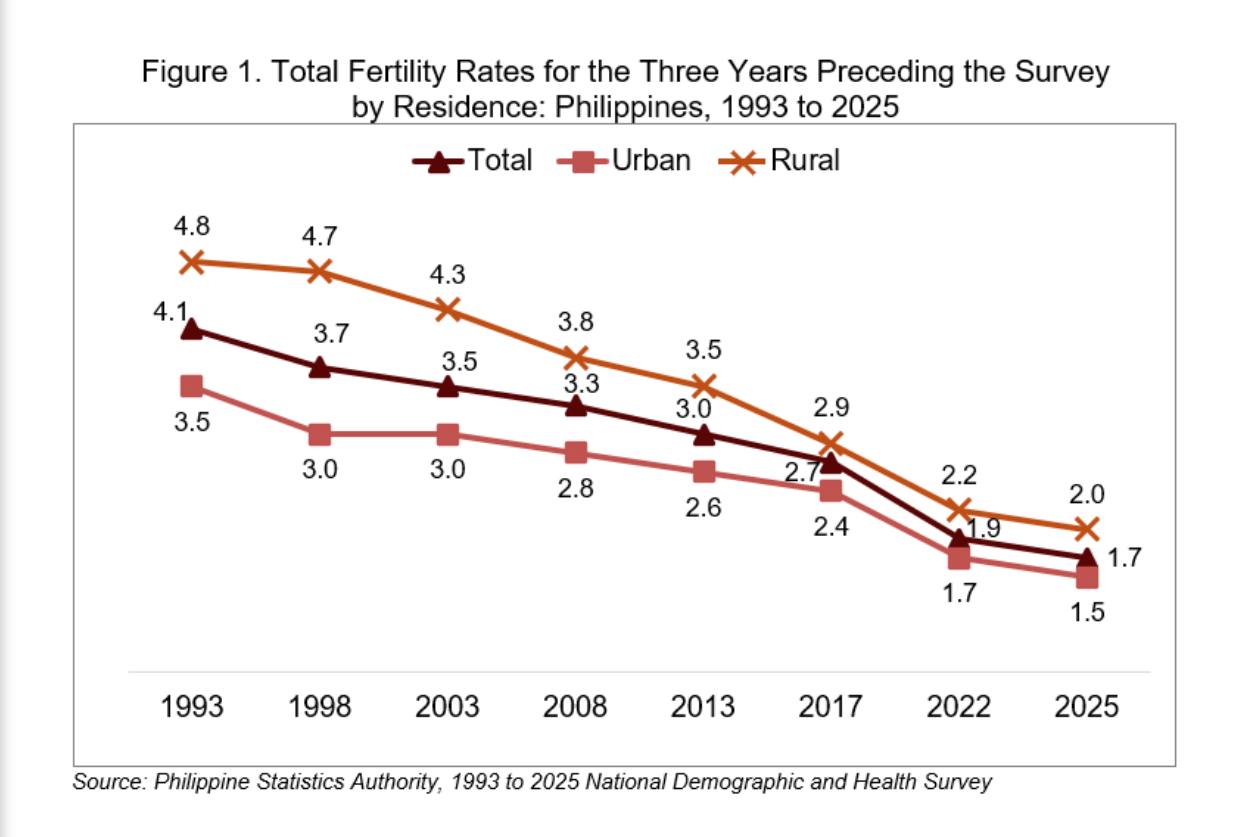
The country’s Total Fertility Rate has slipped to 1.7 children per woman in 2025, according to the Philippine Statistics Authority. That is a steep drop from the four-child norm of the early 1990s. But the real headline is not just about fewer babies. It is about sharper, more deliberate life choices.
Start with the math. Raising a child today is no longer just a milestone. It feels like a long-term investment plan. Tuition, rent, and grocery bills keep rising, while economic uncertainty refuses to fade. For many households, fewer children mean a better shot at financial stability and a deeper investment in each child’s future.
Then there is timing. Motherhood has been rescheduled. For many millennial and Gen Z Filipinas, building a career, securing finances, and pursuing personal goals now come first.
Children are no longer the opening act but one of several carefully timed chapters.
Behind the scenes, access to reproductive health is quietly rewriting the script. More women are using modern contraception, from pills to permanent methods. This reduces unplanned pregnancies and gives couples firmer control over family size and timing.
Culturally, the definition of a complete family is also getting an update. The once default big household is no longer the gold standard, especially in urban areas. One child or none is increasingly seen not as unusual but as simply another valid life choice.
The pandemic nudged things further along. It amplified financial anxieties and upended life plans, leading many couples to pause or rethink parenthood altogether.
Put it all together, and this is not just a fertility dip. It is a demographic pivot. Filipino women and families are approaching decisions about work, relationships, and children with more intention and more control than ever before.
The 2025 National Demographic and Health Survey, the 13th in a series conducted since 1968 and the first rolled out as a midterm survey, offers a detailed snapshot of these shifts.
A total of 41,602 housing units were selected, with 36,309 found occupied. From these, 36,128 households were successfully interviewed, yielding a 99.5 percent response rate. Among them, 30,223 women aged 15 to 49 were identified as eligible for individual interviews, and 29,694 completed them, for a 98.2 percent response rate.
The data show that 54.2 percent of women are currently married or living with a partner, while 42.7 percent have never married. Only small shares are divorced or separated at 2.4 percent or widowed at 0.7 percent. More than half, or 57.5 percent, live in urban areas, underscoring how city life is shaping family decisions.
Teenage pregnancy remains a concern, though it affects a minority. In 2025, 4.9 percent of women aged 15 to 19 had ever been pregnant, including those who had given birth, were pregnant at the time of the survey, or had experienced pregnancy loss. The share rises steadily with age, from 1.5 percent at age 15 to 9.7 percent at age 19, and is more prevalent in rural areas at 5.8 percent compared with 4.2 percent in urban settings.
Fewer cradles, perhaps, but far more calculation behind each one.