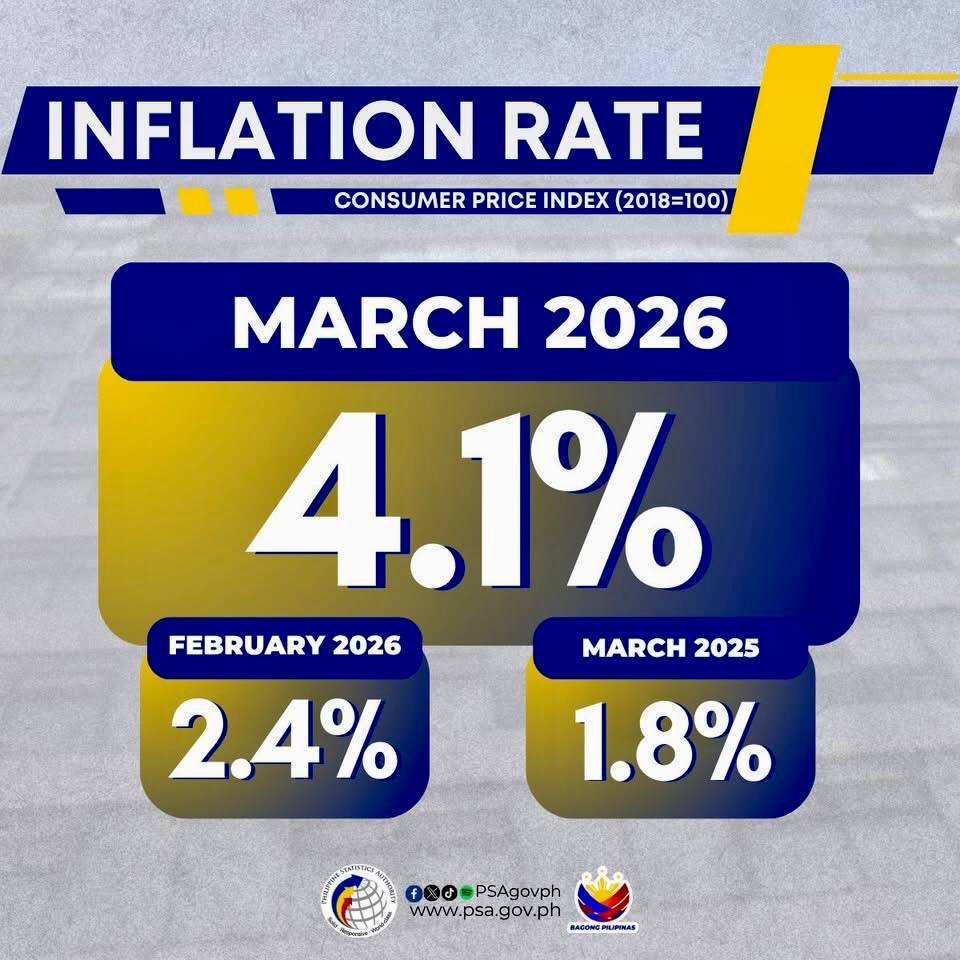
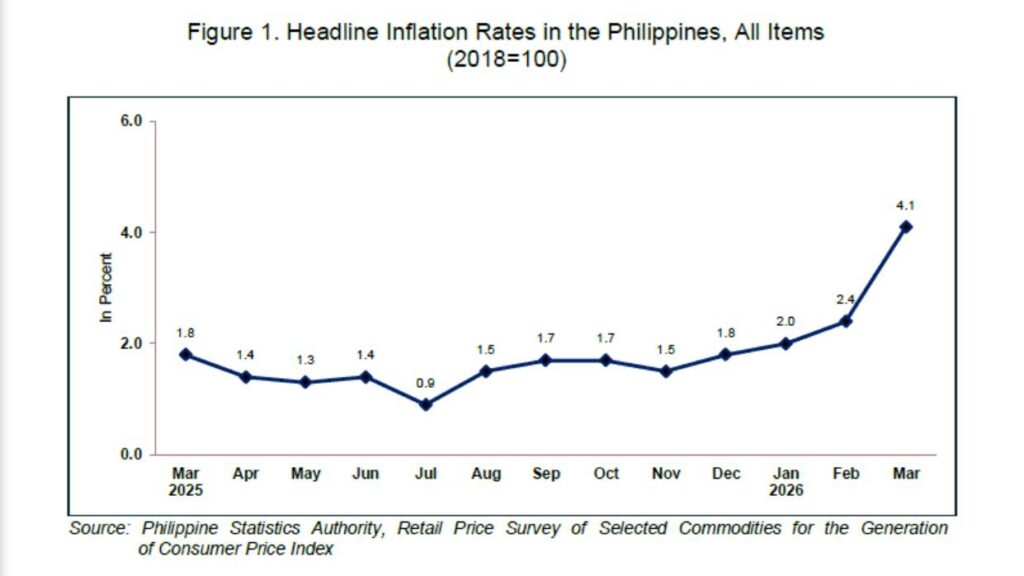
Headline inflation in the Philippines accelerated to 4.1 percent in March, the fastest pace since July 2024 when inflation hit 4.4 percent, driven by higher food prices and surging fuel costs, according to data released Tuesday by the Philippine Statistics Authority.
The latest print, amid escalating tensions in the Middle East, exceeded the Bangko Sentral ng Pilipinas forecast range of 3.1 percent to 3.9 percent and quickened from the 2.4 percent recorded in February, signaling a renewed buildup in price pressures after months of relative easing.
Claire Dennis Mapa, Economic Planning Undersecretary and National Statistician, noted that the last major spike in oil prices began in 2021 and persisted for about two years following Russia’s invasion of Ukraine. And higher oil prices ripple through the economy quickly through increased cost of transport and production costs, which eventually feed into consumer prices, he noted.
“Personally, I hope this episode will be shorter,” Mapa said, but cautioned that upward price pressures are likely to continue in the near term. “We’re already seeing higher numbers for April after a series of fuel price increases, and so far, there are no clear signs that prices will ease anytime soon.”
The PSA attributed the uptick largely to rising prices of key food items, particularly rice, meat, and vegetables, which continue to strain household budgets.
Transport costs also rose sharply, reflecting the impact of surging global oil prices that have increased the cost of moving goods across the supply chain and pushed up logistics expenses nationwide.
Core inflation—which strips out volatile food and energy items to better capture underlying price trends—also climbed to 3.2 percent in March from 2.9 percent in February and 2.2 percent in March 2025. The increase suggests that price pressures are becoming more broad-based and not solely driven by temporary supply shocks.
Price pressures were more pronounced among lower-income households. Inflation for the bottom 30 percent income group rose to 4.2 percent in March, driven by higher food and fuel costs. This was a sharp increase from 2.5 percent in February and 1.1 percent in March last year, underscoring the disproportionate impact of rising prices on financially vulnerable sectors.
The rebound in inflation highlights the economy’s sensitivity to both domestic supply constraints and external cost pressures.
Despite government measures to stabilize food supply and manage imports, inflationary pressures persist, underscoring structural challenges in agriculture and distribution.
Elevated fuel prices, driven by global geopolitical tensions, continue to pose upside risks in the coming months.
The stronger-than-expected inflation print could complicate the central bank’s policy path, as it balances the need to support economic growth with its mandate to keep inflation within target.
The BSP may take a more cautious stance on any policy easing if inflation remains elevated.
While still within a manageable range, the latest data points to renewed upside risks that could dampen consumer spending and weigh on overall economic momentum.