The international aviation landscape changed dramatically in 2026 as regulators and carriers rolled out the most significant updates to lithium-ion battery protocols in a decade.
A surge in thermal runaway events prompted the International Civil Aviation Organization and the International Air Transport Association to standardize power bank restrictions worldwide.
These rules are no longer gentle suggestions; they are now mandatory checkpoints for passengers and crew alike.
Lithium battery safety has long been a concern, but the overhaul followed the total hull loss of an Air Busan Airbus A321 on January 28, 2025. During boarding at Gimhae International Airport, a high-capacity power bank stored in an overhead bin erupted. The resulting fire spread so quickly that even a swift emergency response could not save the aircraft.
The incident exposed a glaring vulnerability. Batteries tucked in overhead bins are harder to access and extinguish than those stowed under seats. ICAO responded by revising its Technical Instructions Doc 9284 on March 27, 2026, requiring that power banks remain within reach of cabin crew.
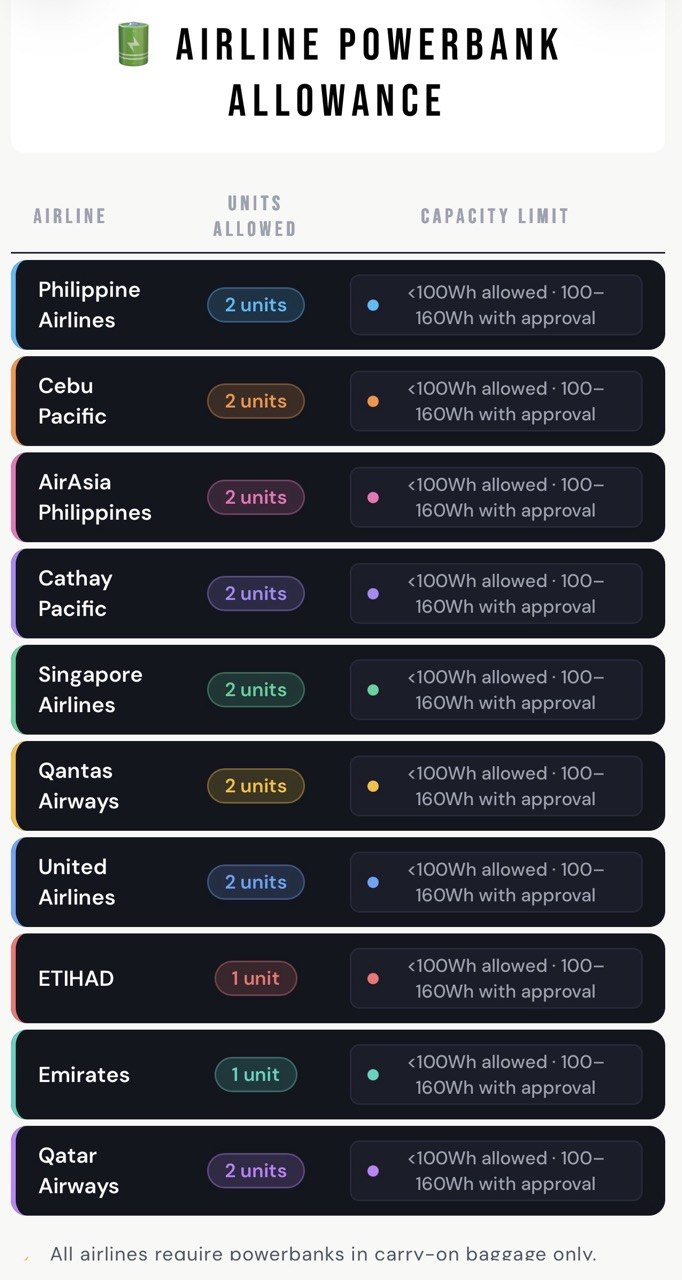
Airlines worldwide have adopted standardized capacity limits and storage rules under IATA guidance and Civil Aviation Authority of the Philippines PCAR Part 18, officially titled “Transportation of Dangerous Goods by Air,” is the local regulation governing the safe handling, packing, labeling, and carriage of hazardous materials on aircraft. Many have banned in-flight usage entirely, turning what was once a passenger convenience into a tightly regulated commodity.
The 100Wh rule remains the gold standard. Travelers can calculate capacity using the formula Wh equals mAh multiplied by volts divided by 1000.
As CAAP aligns local enforcement with these international standards, passengers are advised to ensure all portable chargers display clearly legible manufacturer labels. Devices without a visible Watt-hour rating are now subject to confiscation at security checkpoints.
It would also be interesting to note that Air Asia PH enforces a specific “South Korea Protocol,” where any power bank between 100Wh and 160Wh must receive a clearance sticker from check-in staff before boarding.
This extra layer of verification underscores how seriously airlines are taking even mid-range devices and reinforces the broader trend of tightening portable power control.
Passengers who have long treated power banks as indispensable travel companions may need to recalibrate their expectations.
The era of charging on the go, untethered and unchecked, has ended. Airlines are now the guardians of portable power, and the next time your device dies mid-flight, it may be more than low battery causing the problem. Safety and regulation have taken the lead, and power-hungry passengers must follow suit.