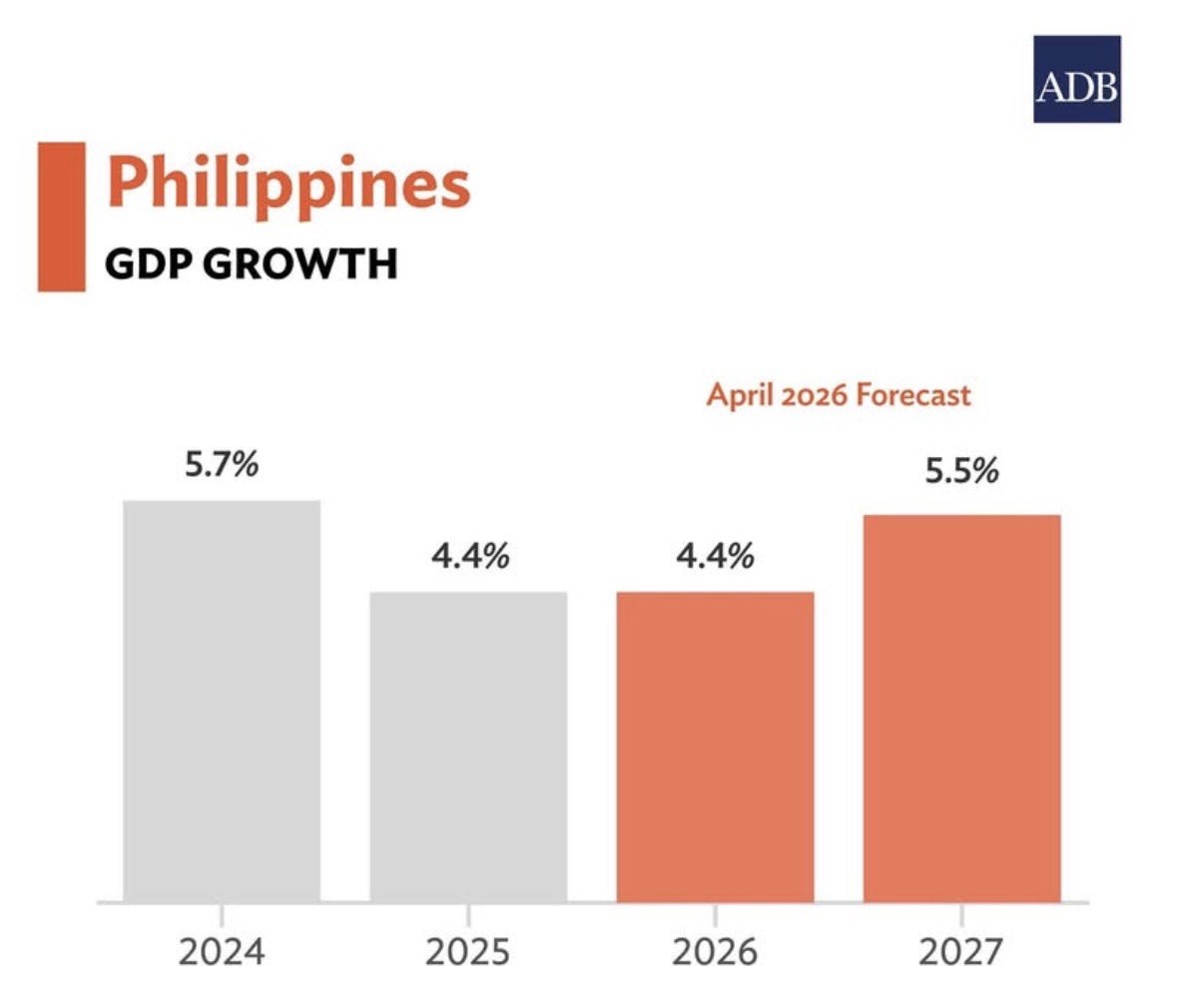
The Asian Development Bank (ADB) has trimmed its growth forecast for the Philippines, underscoring mounting global uncertainty driven largely by the ongoing conflict in the Middle East.
In its Asian Development Outlook (ADO) April 2026, the Manila-based lender now expects the Philippine economy to grow by 4.4 percent this year, unchanged from 2025 but sharply lower than the 5.7 percent projection issued in September. Growth is projected to recover to 5.5 percent by 2027, suggesting current headwinds may prove temporary.
Inflation, however, is set to climb. The ADB raised its 2026 inflation forecast to 4 percent, the upper bound of the government’s target range, from 1.7 percent in 2025 and above its earlier 3 percent estimate. Price pressures are expected to ease modestly to 3.5 percent by 2027.
Despite the downgrade, domestic demand remains a key pillar. Investment activity is likely to gain traction from earlier policy rate cuts, whose effects typically materialize with a lag. Yet rising costs could blunt this momentum, dampening both corporate expansion and household spending.
A central risk lies in energy. As a net fuel importer, the Philippines is particularly exposed to spikes in global oil prices tied to geopolitical tensions. Elevated energy costs could ripple through transport, food, and manufacturing sectors.
ADB officials warn that these vulnerabilities highlight the urgency of structural reforms—from strengthening human capital to improving the investment climate and protecting low-income households.
Regionally, growth across developing Asia is expected to slow to 5.1 percent in 2026 and 2027 from 5.4 percent last year, with inflation also edging higher. While resilience persists, prolonged external shocks could test the region’s economic footing.