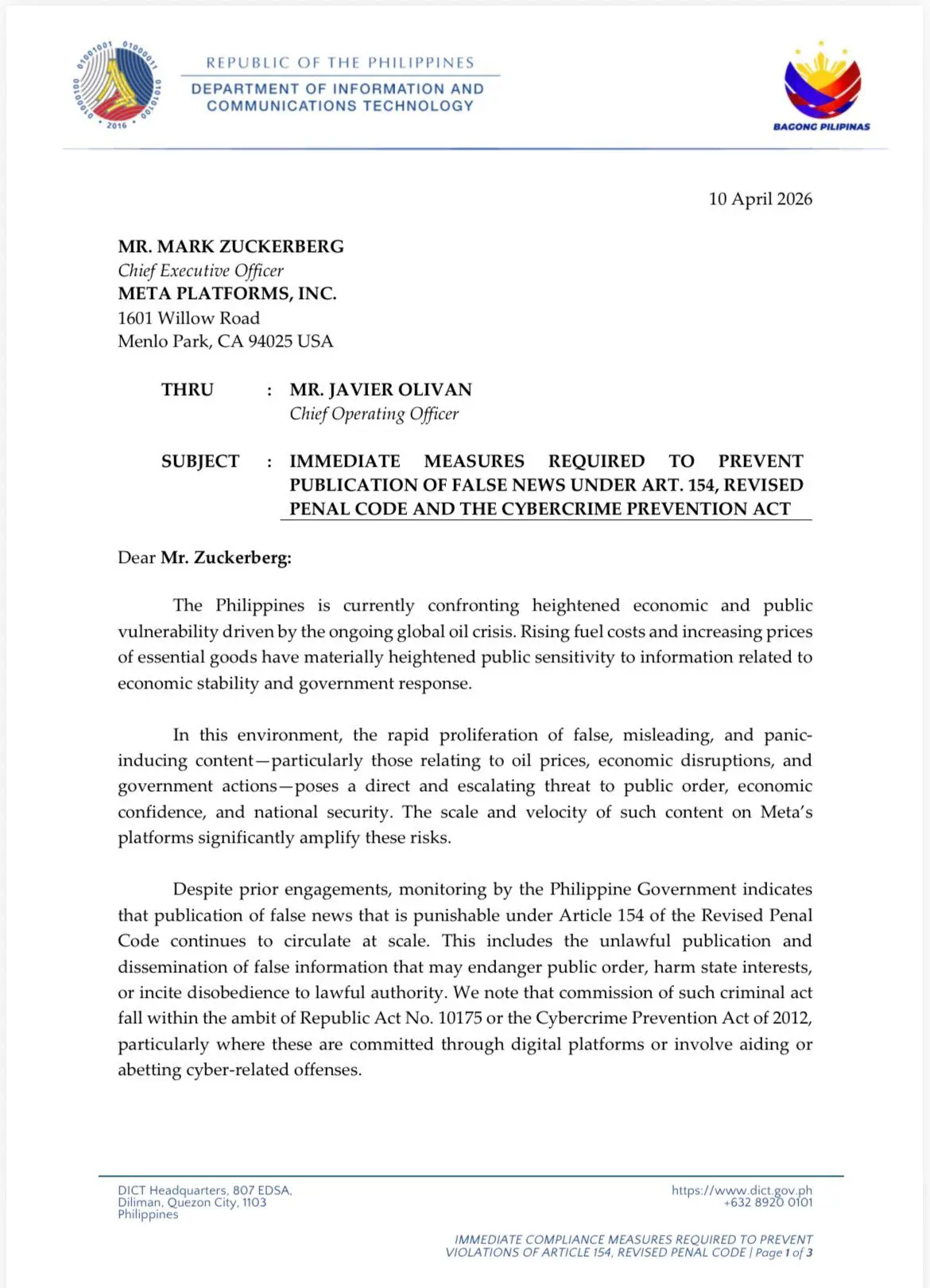
The Philippine government has directed Meta Platforms, Inc. to strengthen its safeguards against the spread of false and panic-inducing content tied to the ongoing oil crisis, warning of potential legal action if the company fails to act swiftly.
In a joint letter dated April 10 to CEO Mark Zuckerberg, the Department of Information and Communications Technology (DICT) and the Presidential Communications Office (PCO) said the continued circulation of disinformation on Meta’s platforms may violate existing laws, including provisions of the Revised Penal Code and the Cybercrime Prevention Act of 2012.
The agencies set clear deadlines for compliance, requiring Meta to confirm receipt of the directive within 48 hours and submit a detailed implementation plan within seven calendar days.
Failure to meet these requirements, they said, could trigger regulatory and legal measures in coordination with other government bodies.
Officials underscored the urgency of the directive, citing heightened public sensitivity amid rising fuel costs. The situation, they noted, has increased the risk that false information could undermine public order and economic stability.
The letter warned that the rapid spread of misleading and panic-driven content poses an “escalating threat” to economic confidence and national security.
Authorities flagged a range of harmful posts circulating online, including fabricated health reports about senior officials and false advisories on oil prices, energy supply, and financial systems.
Such misinformation, they cautioned, could spark panic buying, distort prices, and lead to violations of the Price Act.
The DICT and PCO are calling on Meta to deploy more robust detection systems, accelerate content takedowns, and establish round-the-clock coordination with government agencies.
They emphasized the need for “immediate, concrete, and verifiable action” to contain the spread of harmful content.