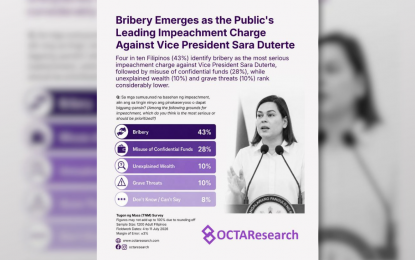
Bribery has emerged as the impeachment allegation against Vice President Sara Duterte that Filipinos consider the most serious, according to the latest nationwide survey by OCTA Research. The findings suggest the public distinguishes among the allegations rather than viewing the impeachment case as a single political issue.
The non-commissioned Tugon ng Masa survey found that 43 percent of adult Filipinos identified bribery as the gravest impeachment allegation, well ahead of the alleged misuse of confidential funds, which was cited by 28 percent of respondents.
OCTA said the results indicate that Filipinos are weighing the charges based on their perceived seriousness rather than simply expressing support for or opposition to the impeachment proceedings.
The survey also found significant regional differences in public opinion. While bribery ranked as the top concern nationwide and across nearly every major demographic group, including age, gender, residence, and socioeconomic class, the alleged misuse of confidential funds emerged as the leading concern in several regions.
According to OCTA, the regional variation suggests that public perceptions are shaped by local political contexts and information environments rather than by a single national narrative surrounding the impeachment case.
The polling firm added that the consistency of bribery as the leading concern across most demographic groups points to broad agreement on its relative seriousness despite differing regional priorities.
The survey was conducted from July 4 to 11 through face-to-face interviews with 1,200 adults nationwide. It has a margin of error of plus or minus 3 percentage points at the 95 percent confidence level, while estimates for the National Capital Region, Balance Luzon, Visayas, and Mindanao have a margin of error of plus or minus 6 percentage points.
OCTA released the findings as part of its regular Tugon ng Masa survey series. The results measure public perceptions of the impeachment allegations and do not constitute findings on the truth or legal merits of the accusations, which remain subject to constitutional processes.