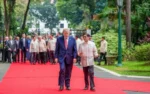
President Ferdinand Marcos Jr. may have served up Jollibee Chickenjoy to warm up his visiting American counterpart, but the bigger question is what the Philippines served up at the negotiating table. US President Donald Trump emerged from the visit celebrating a “landmark” trade deal that he said would be particularly good for American farmers and energy businesses. Apparently, Trump had his Chickenjoy and ate it too.
That would be amusing enough if the deal did not carry potentially serious consequences for Philippine agriculture, which already runs a substantial trade deficit with the United States. Trump has offered few details, leaving local industries and farmers guessing just how much additional access American products will get to the Philippine market, and what the country secured in return.
Washington does have a legitimate grievance. The US Trade Representative reported an USD8.5-billion goods trade deficit and a USD3.6-billion services deficit with the Philippines in 2025, giving the Americans a combined USD12.1-billion shortfall. Trump wants to narrow that gap, and he has made no secret of his determination to use trade negotiations to advance American commercial interests.
But the bilateral trade picture is not quite as simple as the headline numbers suggest. While the broader relationship favors the Philippines, agriculture is already tilted heavily in America’s favor.
Philippine Statistics Authority figures show that the country imported USD275.66 million in American agricultural products in September alone, against exports of just USD96.46 million. That produced a USD179.2-million deficit for the month. For 2025, the agricultural trade gap reached USD1.52 billion, following an even larger USD1.95-billion shortfall in 2024.
This is the uncomfortable arithmetic the government must confront. Addressing Washington’s overall trade deficit by opening the Philippine market further to American farm products could deepen an imbalance that local producers are already struggling to overcome. Greater imports may benefit consumers through more competitive prices and give manufacturers access to agricultural inputs that are insufficiently produced locally. But those gains must be weighed against the risks of depressing farmgate prices, squeezing domestic producers and discouraging investment in local agriculture.
The Federation of Philippine Industries, through chairperson Elizabeth Lee, has rightly insisted on reciprocity. Better access for American goods should be matched by meaningful opportunities for Philippine exports. Energy purchases, meanwhile, must remain commercially competitive rather than become another concession.
Filipino-Chinese business leaders have likewise called for clearer terms, an entirely reasonable demand when commitments could affect entire industries, investments and jobs.
The government owes the public a full accounting of what was negotiated, which products will receive greater access, what safeguards will protect local producers and what concrete concessions Filipino exporters secured.
Chickenjoy may be an excellent diplomatic icebreaker, but it is no substitute for a good trade bargain. Trump can have his fried chicken and celebrate his deal. The Philippines must make sure its farmers do not end up with the bones.