
For three decades, the Aboitiz Group has been quietly building a real estate portfolio that spans homes, offices, and commercial spaces. But in recent years, it has made a deliberate pivot away from crowded residential battlegrounds toward a less glamorous, far more strategic corner of the market: industrial development. The bet is simple but bold—build where factories, logistics, and infrastructure go first, and let communities grow organically around them.
“For the last five to 10 years, we’ve really focused on the industrial sector,” said Rafael Fernandez de Mesa, president and CEO, Aboitiz Economic Estates | Aboitiz Land. “It may be a smaller part of the overall real estate market, but it’s where we can compete at an advantage.”
That advantage comes from the Group’s breadth. Unlike standalone developers, Aboitiz can pull in muscle from across its businesses—power, water, waste treatment, and construction—to deliver a plug-and-play ecosystem for investors.
In a region where manufacturers compare sites across Southeast Asia, that integration matters.
Industrial estates as growth engines
Industrial development also shapes where Aboitiz builds. These projects need land—lots of it—and that naturally pushes estates beyond traditional urban cores.
What once felt far-flung, however, is now becoming accessible thanks to years of public infrastructure spending.
Take LIMA Estate in Batangas.
“Ten years ago, it felt really far,” Fernandez de Mesa said. “Today, it takes just over an hour to get from Metro Manila to LIMA.” The same logic applies to TARI Estate in Tarlac, which now sits beside the fast-emerging Metro Clark growth corridor.
The timing is intentional. As roads improve and logistics costs fall, these areas become viable not just for factories but for entire townships. And because industrial development requires heavy capital and specialized expertise, competition is thinner.
“Our competitive sandbox isn’t just the Philippines,” Fernandez de Mesa said. “We’re competing with Vietnam, Thailand, Malaysia, Indonesia—the world. That forces us to operate at a world-class level.”
More than factories and warehouses
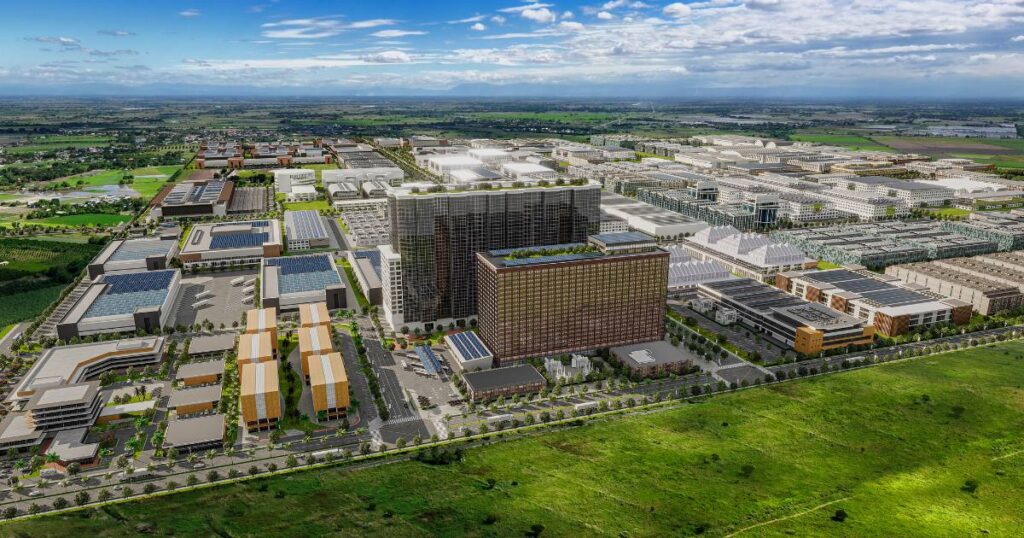
Aboitiz is careful to stress that it is not building old-school industrial parks. Its economic estates are industrial-anchored townships, designed to evolve as employment rises.
“Industry is the catalyst,”
Fernandez de Mesa explained. “Once companies come in, they create jobs. Those people need housing, retail, schools, places to relax. So over time, we add the complementary components.”
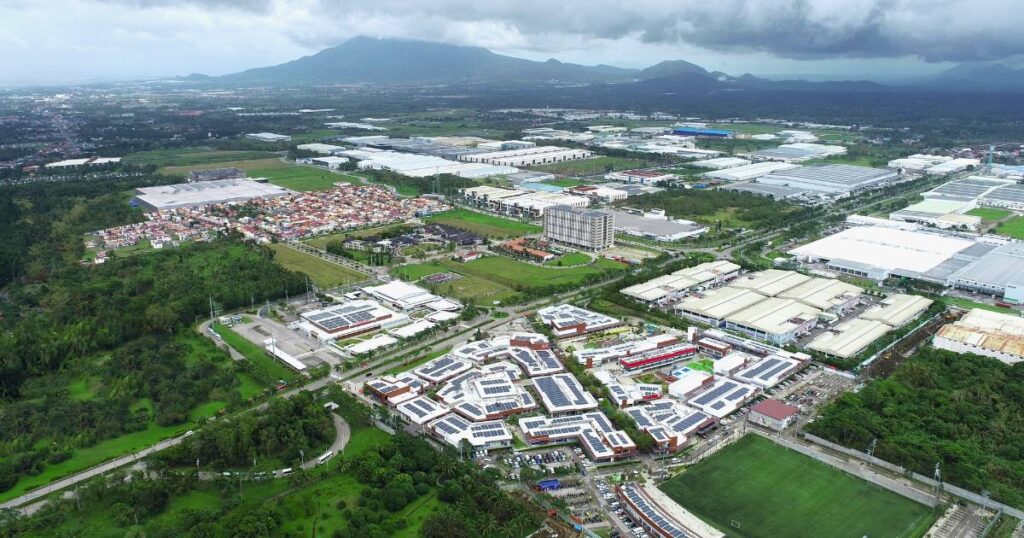
LIMA Estate, now the Group’s most mature project, shows how that evolution plays out. From about 50 companies and 20,000 workers a decade ago, it has grown to nearly 196 companies — 130 operating and 66 in varying stages of construction — employing 75,000 people today. It now hosts not just manufacturers but IT-BPM firms, creative industries, and service providers.
Last year, LIMA opened Batangas’ first office building designed specifically for IT-BPM locators.
TARI Estate is earlier in its journey but following the same script. Coca-Cola and Ajinomoto will begin building their facilities this year, and planning for housing, retail, and services is already underway. The estates also serve communities beyond their gates. LIMA, for instance, sits amid cities and municipalities with a combined population of about one million, creating a natural overlap between estate users and surrounding residents.
Different estates, Fernandez de Mesa noted, suit different locator needs. Firms that rely on dense supply chains may prefer LIMA’s maturity, while those seeking scale and future growth may choose TARI.
Sustainability, talent, and the long game
As global companies sharpen their ESG requirements, Aboitiz has leaned into sustainability as a competitive lever.
Instead of relying solely on international certifications, the Group worked with the Philippine Green Building Council to pioneer district-level standards.
In 2022, LIMA became the country’s first BERDE five-star certified district, a distinction now shared by Aboitiz estates in Cebu.
Equally strategic is talent. Inside LIMA, Aboitiz helped establish Edustria, a senior high school, and has partnered with Batangas State University to build a full campus within the estate. An initial “interim campus” will open this August, eventually serving thousands of students trained under industry-designed curricula.
This isn’t about boosting residential sales. It’s about ensuring companies can find skilled workers on day one.
Looking ahead, Aboitiz is already consolidating land to expand LIMA from 1,100 to about 1,500 hectares and growing TARI through partnerships.
It is also scouting new sites in Luzon and high-potential cities like Iloilo, Davao, and Cagayan de Oro. Data centers, Fernandez de Mesa believes, are inevitable future locators given the estates’ power and security advantages.
Perhaps most striking is his view on competition. “I don’t see local developers as competitors,” he said. “None of us can supply all the demand. When one of us succeeds, the country succeeds.”
In Aboitiz’s playbook, growth starts with industry—but it doesn’t end there.