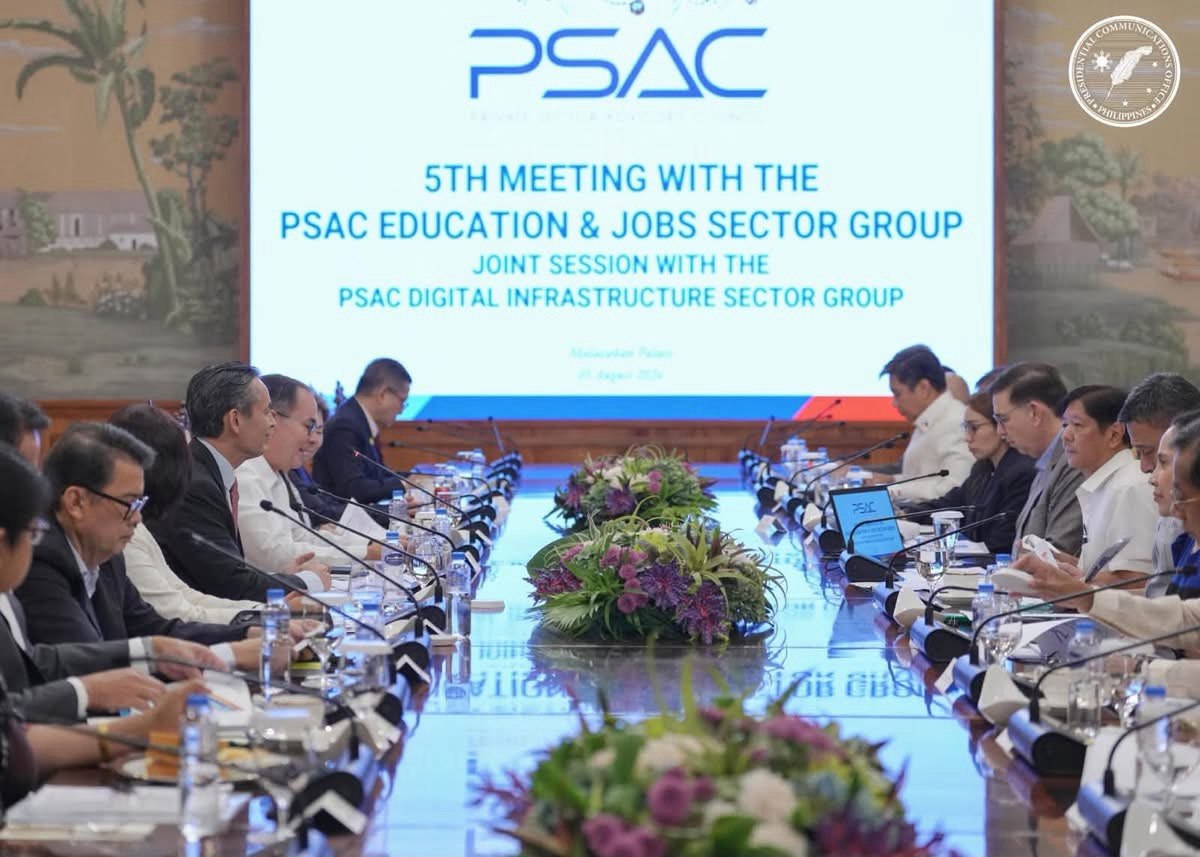
The Private Sector Advisory Council (PSAC) is urging the government to fast-track the country’s artificial intelligence agenda, proposing a national task force and education reforms designed to equip Filipino workers for an economy increasingly shaped by AI and advanced technologies.
The recommendations were presented during the fifth meeting of the PSAC Education and Jobs Sector Group, held jointly with the Digital Infrastructure Sector Group and chaired by President Ferdinand R. Marcos Jr. at Malacañang.
At the center of the proposal is the creation of a National AI Implementation Taskforce through an Administrative Order. The body would bring together government agencies, industry, academe, and other stakeholders under a single framework to coordinate AI adoption, workforce development, research, and governance.
The recommendation signals a shift from AI strategy to execution. While the Philippines already has a National AI Strategy, business leaders have increasingly emphasized the need for stronger coordination to translate policy into investments, workforce training, and commercial applications.
PSAC also proposed releasing P650 million from the Higher Education Development Fund to the Commission on Higher Education to finance AI upskilling programs in colleges and universities beginning in 2026, with the aim of producing more graduates equipped for AI-driven industries.
Beyond artificial intelligence, the council called for faster implementation of the Semiconductor and Electronics Industry Roadmap, arguing that the sector remains one of the country’s strongest opportunities for attracting investments and creating high-value jobs as global supply chains continue to diversify.
PSAC likewise urged closer collaboration among government, educational institutions, and the private sector to address the longstanding mismatch between graduates’ skills and employers’ needs through faster curriculum updates and industry-aligned training programs.
The recommendations complement ongoing initiatives covering job fairs, digital and financial literacy, and support for micro, small, and medium enterprises.
Together, they reflect a broader recognition that the country’s competitiveness will increasingly depend not only on digital infrastructure but also on how quickly its workforce can adapt to technological change. As artificial intelligence reshapes industries from manufacturing to business process management, the challenge for policymakers is shifting from creating jobs to ensuring Filipino workers have the skills to fill the higher-value roles emerging alongside them.