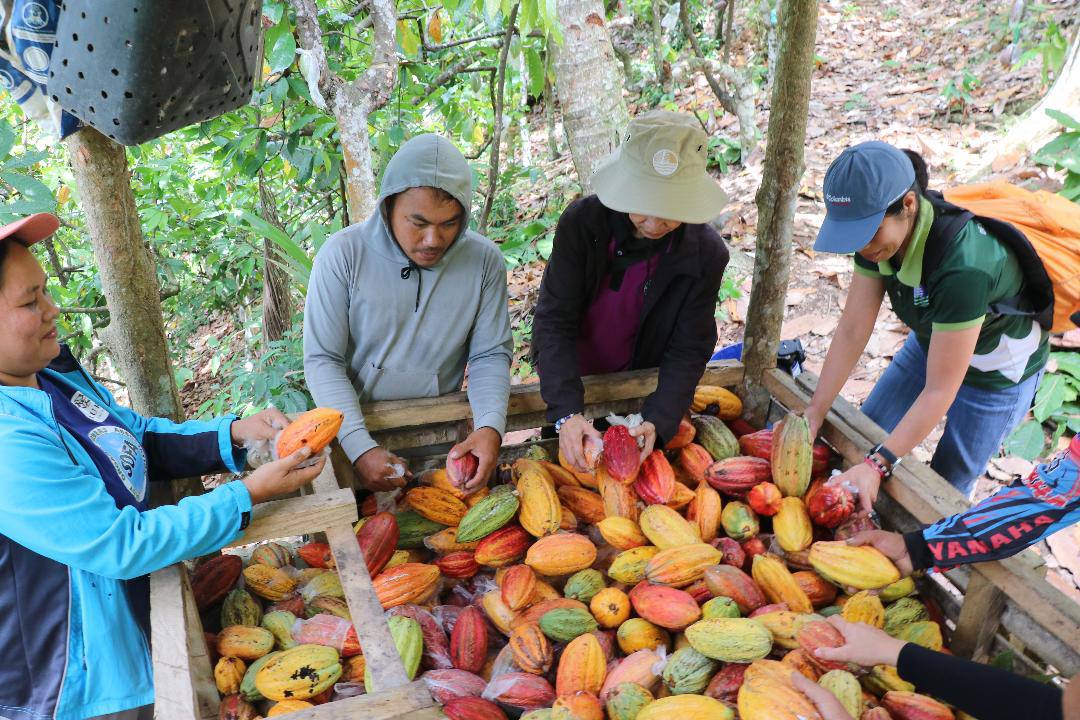
Farmers in Barangay Saloy, Calinan, once struggled with unstable earnings from corn and banana, with idle cogon-covered land offering little hope for better lives. Today, their shift to high-quality cacao agroforestry backed by government and private support has lifted their livelihoods, restored forests, and earned international recognition for their produce.
Policarpo Enricoso, head of the Saloy Organic Farmers Association (SOFA), recalled how basic necessities were once hard to afford. Reliance on low-priced crops and unproductive land left families with few options until the Department of Environment and Natural Resources (DENR) stepped in through its Enhanced National Greening Program (eNGP) starting in 2018. What began as a 100-hectare project transformed idle areas into thriving plantations, later expanded to a new 72-hectare site awarded in 2024 due to the group’s excellent management.
Partnering with Auro Chocolate Inc., the farmers adopted organic practices, with 19.21 hectares now fully certified organic and the rest in process. They use no synthetic inputs, cutting costs while protecting the environment and producing premium beans. The results have been life-changing: Enricoso reported annual incomes exceeding ₱200,000, tripling when cacao prices rose, and further gains as dried beans fetched ₱300 to ₱400 per kilogram in 2025—with organic beans earning an extra 10 to 15 percent.
Their quality reached global standards in 2024 when SOFA took home the Silver Award at the international Cacao of Excellence competition, following national recognition. This honor opened wider markets and boosted demand. The model blends environmental care with economic growth: the expanded plantation mixes cacao with timber, fruit trees, and bamboo, creating jobs within the community across farming and post-harvest work.
DENR Secretary Juan Miguel “Mitch” T. Cuna cited SOFA as proof that environmental programs can uplift communities, aligning with President Ferdinand R. Marcos, Jr.’s vision for reforestation that also generates livelihood. The agency has provided over ₱2.6 million in aid, plus ongoing monitoring and support. Future plans include water infrastructure, processing partnerships, agri-tourism, and securing long-term land management agreements to sustain progress.
From neglected lands to world-class cacao, Saloy’s farmers demonstrate how combining government backing, private sector links, and community dedication turns local struggle into global achievement, proving environmental stewardship and economic progress go hand in hand.