The ASEAN+3 Macroeconomic Research Office (AMRO) has sharply cut its Philippine growth forecasts for 2026 and 2027, leaving the economy trailing most of its Southeast Asian peers as inflation, weak investment and external pressures constrain activity.
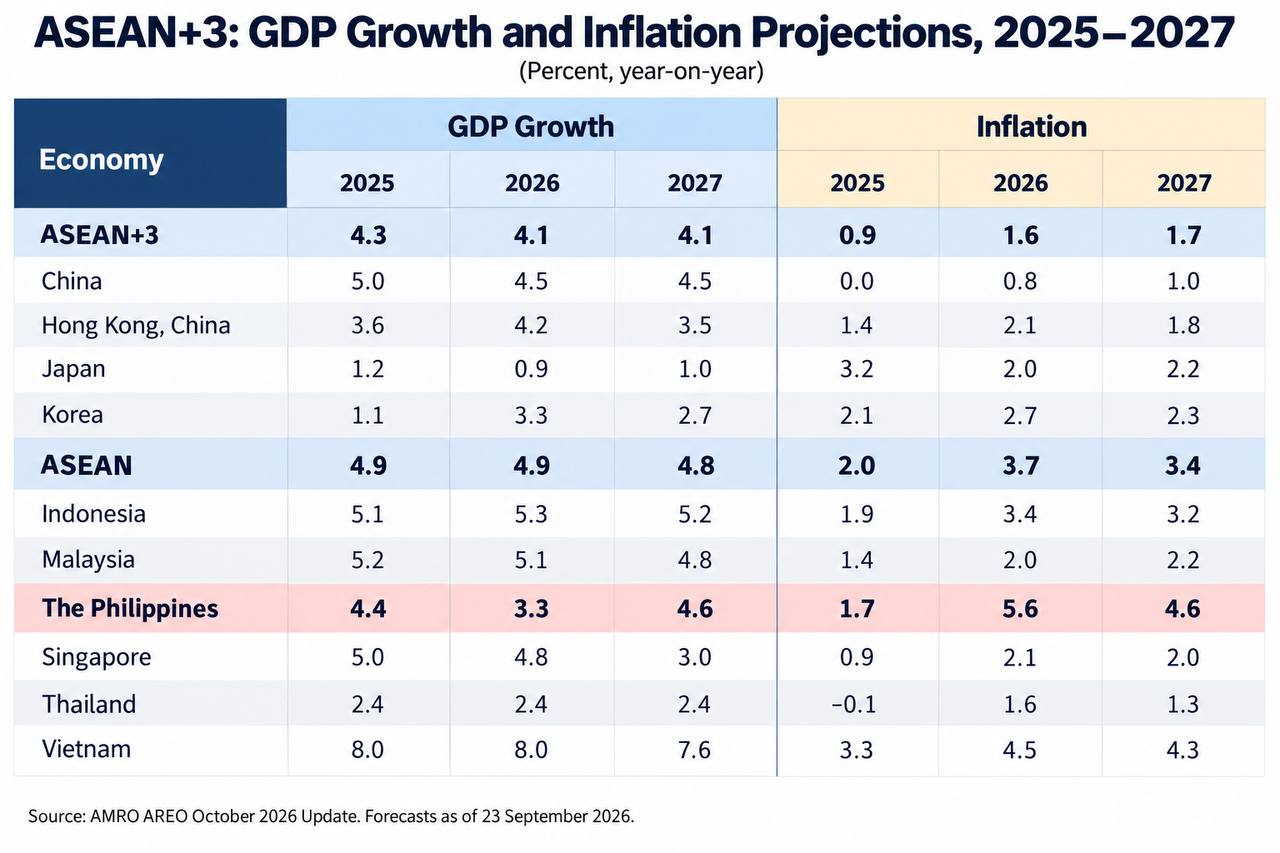
AMRO now expects the Philippine economy to expand just 3.3% in 2026, down 0.8 percentage point from its July forecast of 4.1%. Its 2027 projection was reduced by an even wider margin, to 4.6% from 5.5%.
The downgrade comes as AMRO turns more upbeat on the broader region. It raised its ASEAN growth forecast for 2026 to 4.9% from 4.8%, while retaining its 4.8% projection for 2027. ASEAN+3 growth is seen at 4.1% this year, with the 2027 forecast raised to 4.1% from 4%.
The Philippines is therefore projected to grow 1.6 percentage points slower than ASEAN in 2026 and 0.2 point slower in 2027. AMRO expects Vietnam to grow 8% this year, followed by Indonesia at 5.3%, Malaysia at 5.1% and Singapore at 4.8%. Brunei Darrusalam, Myanmar, and Thailand are the only ASEAN economies with lower 2026 growth forecasts than the Philippines. Lao PDR’s forecast is 4.6%, above the Philippines’ 3.3%, while Brunei’s is 1.9%.
AMRO cited elevated energy-driven inflation, weaker public investment and pressure on service exports among the Philippines’ key headwinds. Public construction contracted 31.5% in the first quarter following delays and cancellations of infrastructure projects, while the IT-BPM industry faces growing exposure to AI-driven automation.
Inflation is adding to the challenge. AMRO trimmed its 2026 Philippine inflation forecast only slightly, to 5.6% from 5.7%, but raised its 2027 projection to 4.6% from 4.1%.
Food remains a particular vulnerability. Food accounts for 34.8% of the consumer price basket and rice 8.9%, while AMRO estimates rice-stock coverage at only 1.8 months. It also expects the current El Niño to intensify toward the end of 2026, with economic effects potentially extending into 2027.
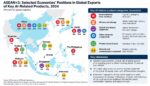
The economy retains some buffers, including remittances and AI-linked electronics demand. But with electronics concentrated in lower-value assembly, testing and packaging, the Philippines may capture less of the AI investment boom than some regional competitors.
The outlook leaves policymakers facing a difficult balance: growth needs support even as persistent inflation limits the room for broad demand stimulus.