Government agencies are emerging as a significant driver of demand for quality office space in Metro Manila’s Bay Area, capitalizing on competitive rental rates and available properties as the district adjusts to the exit of Philippine offshore gaming operators (POGOs).
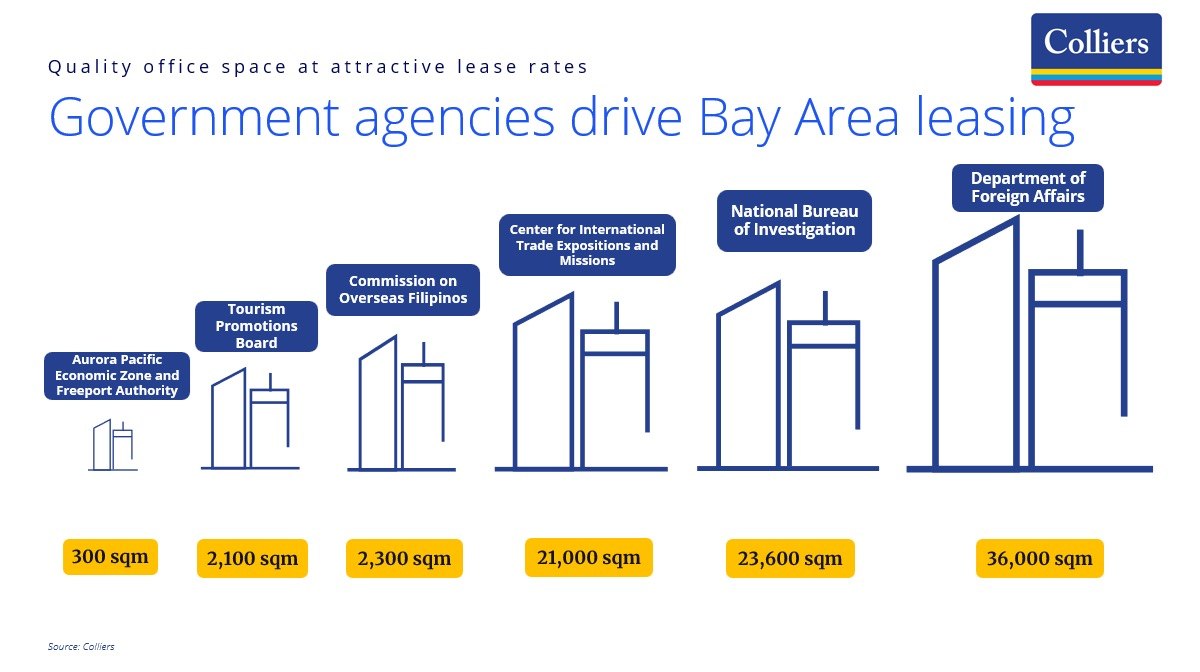
Property consultancy Colliers Philippines reported that six government agencies account for a combined 85,000 square meters of office space, underscoring the growing role of public-sector occupiers in a market previously reliant on offshore gaming companies.
The Department of Foreign Affairs represents the largest requirement at 36,000 square meters, followed by the National Bureau of Investigation at 23,600 square meters and the Center for International Trade Expositions and Missions at 21,000 square meters. Other agencies include the Commission on Overseas Filipinos, Tourism Promotions Board and Aurora Pacific Economic Zone and Freeport Authority.
The shift reflects an opportunity for government institutions to secure larger, accessible workplaces at relatively attractive lease rates. For landlords, these requirements could help absorb available space and support occupancy amid a changing tenant landscape.
“Government agencies are becoming an increasingly important source of demand in the Bay Area office market,” said Colliers Senior Director Maricris Sarino-Joson, noting the public sector’s contribution to occupancy, market stability and the district’s business appeal.
However, government leasing alone may not be enough to restore the market to its former strength. The scale and pace of recovery will also depend on private-sector demand, landlords’ ability to match tenant requirements and the district’s capacity to attract a broader mix of businesses.
Colliers Research Head Joey Roi Bondoc said increased government leasing could generate spillover demand for residential and retail properties, extending the benefits beyond office buildings.
“This is important to ensure a sustained recovery of the Bay Area post-POGO,” Bondoc said.
Colliers expects sustained government requirements, alongside a recovery in private-sector leasing, to support the district’s gradual rebound. The emerging public-sector demand offers a measure of stability, but a durable recovery will ultimately hinge on diversifying the tenant base and rebuilding broader commercial activity.