The Philippines’ business and investment outlook is deteriorating as rising public debt, slowing economic growth and weakening foreign investment inflows intensify fiscal and economic pressures, according to a new assessment by WR Advisory Group.
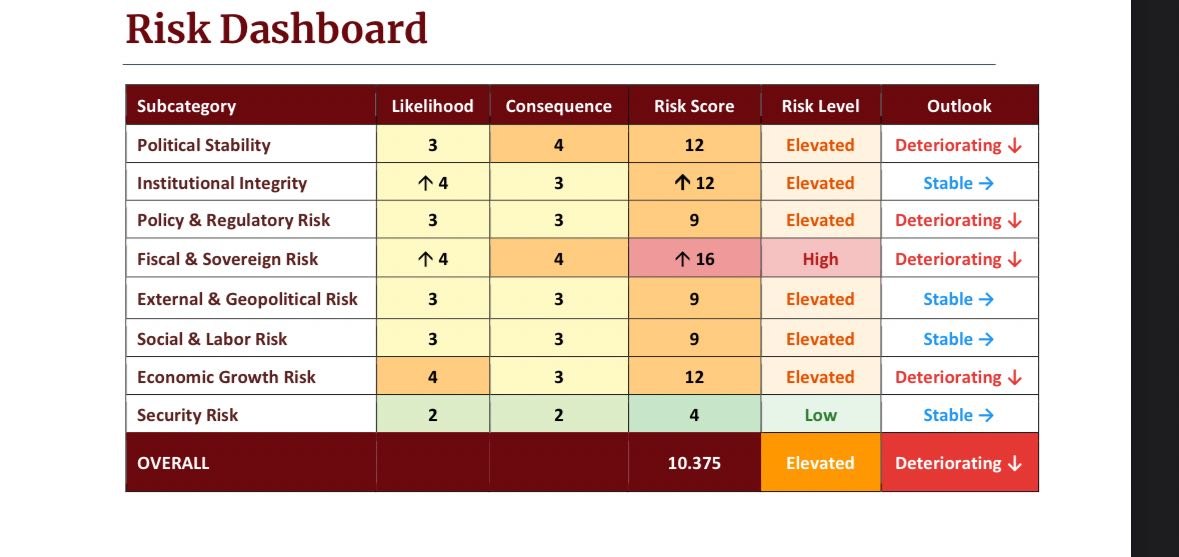
The Manila-based consultancy gave the country an overall risk score of 10.375 out of 25 for the second quarter of 2026, placing it in the “Elevated” risk category with a “Deteriorating” outlook in its inaugural Philippine Political & Country Outlook Report.
Fiscal and sovereign risk stood out as the most pressing concern, receiving a “High” rating. Six other risk categories were classified as elevated, while security risk remained low, indicating that economic and governance-related pressures outweighed immediate security concerns in the assessment.
National government debt reached P19.07 trillion, equivalent to 66% of gross domestic product, at the end of June, the report said. Debt service totaled P1.23 trillion in the first half of the year, while negative credit rating signals from S&P and Fitch added to concerns over the country’s fiscal position.
Growth momentum has also weakened. Philippine gross domestic product expanded by 2.3% in the second quarter, marking four consecutive quarters of deceleration. Foreign direct investment inflows fell 33.4% through May, raising concerns about the country’s ability to attract and sustain foreign capital amid an increasingly uncertain business environment.
WR Advisory President and CEO Robin Michael Garcia said businesses need stronger political risk intelligence to navigate uncertainty and inform investment decisions.
The report identified political stability, regulatory policy, fiscal conditions and economic growth as areas likely to deteriorate further over the following 90 days.
External, social and security risks, meanwhile, were assessed as stable despite ongoing geopolitical tensions and inflationary pressures.
The outlook highlights a challenging environment for investors, although the risk classification is an assessment rather than a prediction of an economic crisis. The extent of the impact will depend on fiscal management, policy consistency and the government’s ability to restore growth and investor confidence.