The University of the Philippines College of Law Class of 1976 will mark its golden jubilee on Friday with an unusual anniversary gift: a Supreme Court victory in its decades-long fight against political dynasties.
Four classmates, whose petition helped bring the issue before the high court, secured a landmark ruling directing Congress to enact a law prohibiting political dynasties, as required by the 1987 Constitution.
Wilfredo M. Trinidad, Rico V. Domingo, Jorge L. Cabildo, and Ceasar G. Oracion filed a petition for mandamus on March 19, 2024. Their case, G.R. No. 272370, was heard alongside three related petitions.
In an 86-page decision dated August 26, 2026, the Supreme Court ruled that Congress’ 39-year failure to enact an anti-political dynasty law constituted grave abuse of discretion and violated a mandatory constitutional duty. Associate Justice Ramon Paul L. Hernando penned the decision.
The Court unanimously declared that Article II, Section 26 of the 1987 Constitution requires Congress to pass a law prohibiting political dynasties. By majority vote, it granted the petitions for mandamus and directed lawmakers to enact the appropriate legislation with utmost urgency and at the earliest opportunity.
The ruling, however, does not immediately ban political dynasties or disqualify candidates related to incumbent officials. Congress retains the authority to define what constitutes a political dynasty, determine which family relationships and political arrangements the prohibition will cover, and establish how the ban will be enforced.
The Court also rejected a separate petition seeking to compel the Commission on Elections to issue rules disqualifying candidates belonging to political dynasties, ruling that the constitutional prohibition cannot be enforced against candidates until Congress passes the necessary implementing law.
The legal battle also spilled into public discussions while the case was pending. Trinidad and Domingo prepared a presentation for a forum titled “Political Dynasties: Biyaya o Parusa?” organized by the UP Law Center’s Institute of Government and Law Reform at Malcolm Theater on May 24, 2024.
Former election commissioner Rene Sarmiento, a member of the 1986 Constitutional Commission, discussed the origins of the constitutional provision.
In February 2025, Oracion organized another symposium at Saint Louis University in Baguio, where he had served as dean of the law school.
The milestone adds another distinction to a class already known for its Bar performance. All its candidates passed the 1976 Bar examinations, with two graduates placing first and eighth.
Led by class president Atty. Victoria Delos Reyes, the Golden Jubilarians also thanked the UP Law Alumni Association for recognizing their 50 years since graduation.
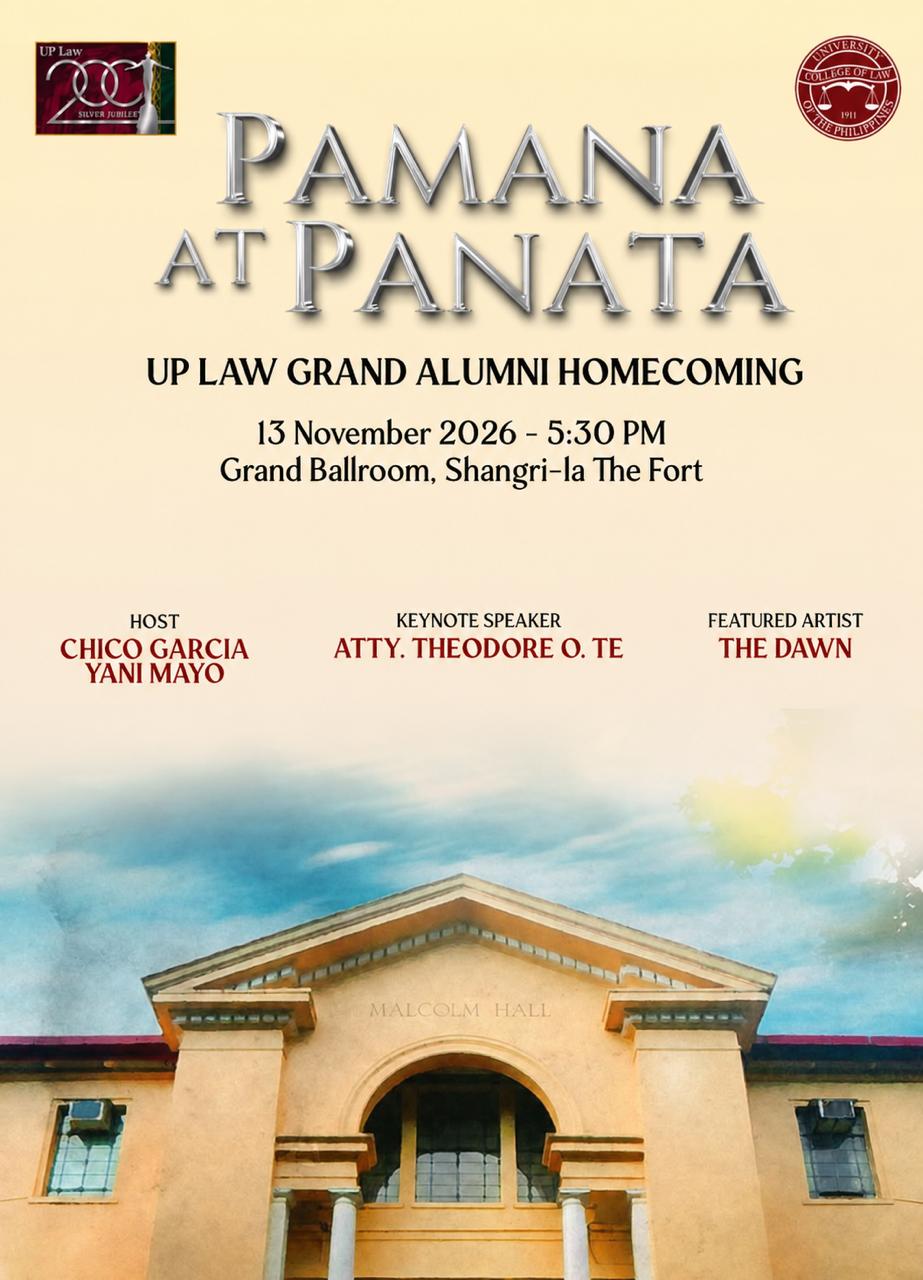
The Class of 2001, this year’s Silver Jubilarians, will host the UP Law Grand Alumni Homecoming under the theme “Pamana at Panata.” The celebration starts at 5:30 p.m. on November 13 at the Grand Ballroom of Shangri-La The Fort in Bonifacio Global City, Taguig.
For the Class of 1976, the golden anniversary comes with a distinction beyond professional longevity: helping turn a constitutional promise, left unfulfilled for nearly four decades, into a judicial directive for Congress to finally act.