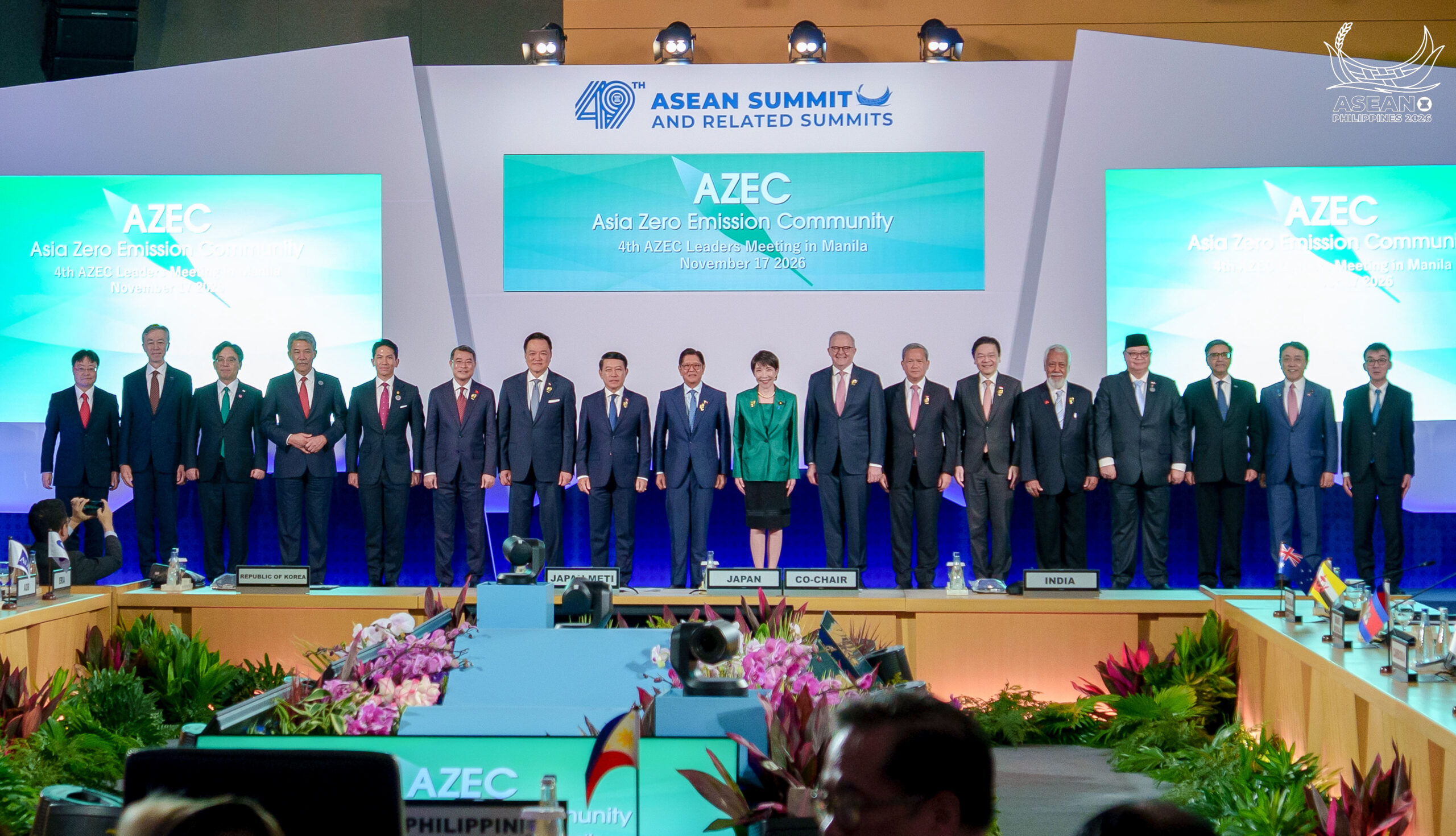
Top leaders from the Asia Zero Emission Community (AZEC) convened for the fourth AZEC Leaders Meeting, co‑chaired by Japan’s Prime Minister Sanae Takaichi and Philippine President Ferdinand R. Marcos Jr., to overhaul the bloc’s energy roadmap, shore‑up regional petroleum security, and tie climate action to sustainable economic growth. Held starting at 10:35 a.m. local time for approximately 50 minutes, the high‑level gathering reimagined the existing AZEC partnership as “AZEC 2.0” to address mounting regional energy‑supply concerns.
Prime Minister Takaichi opened the summit by calling for the full‑scale expansion of “POWERR Asia,” the regional energy‑cooperation concept launched this year, as the core foundation of AZEC 2.0. She also introduced Japan’s complementary “POWERR Gulf” initiative, designed to boost economic and energy resilience across Middle‑Eastern Gulf states, creating stronger, more reliable cooperation between oil‑producing nations and major energy consumers throughout Asia. Takaichi emphasized that climate action and robust economic growth were not competing priorities, explaining that Japan would serve as a critical bridge linking oil‑producing economies with Asian markets; she added that the AZEC mission fully aligns with the updated vision of a Free and Open Indo‑Pacific (FOIP).
President Marcos, acting as the meeting’s co‑chair and the current ASEAN Chair, warmly endorsed the POWERR Asia expansion and the transition toward AZEC 2.0. Marcos highlighted key Philippine and Southeast‑Asian regional energy programs, noting these initiatives fit squarely within AZEC’s goals of energy security, decarbonization, and inclusive economic development.
Japan’s Minister of Economy, Trade and Industry Akazawa presented the official outcomes of the 4th AZEC Ministerial Meeting held in Manila on October 8, 2026. Following the minister’s report, each participating country shared its national and regional energy plans, expressing strong appreciation and high expectations for Japan‑led cooperation frameworks.
Leaders of all AZEC partner countries formally adopted the AZEC Leaders’ Joint Statement, alongside its annex documenting 2025‑2026 progress under the Action Plan for the Next Decade. The bloc also renewed its landmark Next‑Decade Action Plan, introducing a brand‑new pillar centered on economic and energy resilience. These landmark agreements reaffirmed AZEC’s core principles and committed all signatories to accelerate climate‑friendly energy investments and policy implementation over the coming decade.
In a major expansion of the alliance’s reach, the two co‑chairs formally invited India and the Republic of Korea as special guest nations, releasing the Co‑Chairs’ Statement on Strengthening Cooperation between AZEC Partner Countries and Invited Guest Countries. The statement aims to broaden international partnerships, reinforce POWERR Asia, lift regional economic resilience, and advance collective cooperation under the FOIP framework.
In a parallel breakthrough tied directly to the summit’s outcomes, Japan and the International Energy Agency (IEA) issued a joint statement establishing the IEA‑Japan Oil Security Hub for Asia, a landmark facility intended to stabilize regional petroleum supplies, safeguard energy reserves, and strengthen Asia‑wide oil security.
AZEC partner nations include Australia, Brunei Darussalam, Cambodia, Indonesia, Japan, Lao PDR, Malaysia, the Philippines, Singapore, Thailand, and Viet Nam.