
NHA TRANG, Vietnam—A dragon rises against a fairytale castle on Hon Tre Island, where fire, music and 3D projections turn a Vietnamese fantasy into a spectacle. A few minutes away, artificial intelligence is being put to a more practical test, helping cars interpret road conditions and drivers anticipate what lies ahead.
The contrast offered a glimpse of how Vietnam’s Vingroup is bringing together two seemingly different businesses, hospitality and technology, to build a broader regional presence.
At the VinFast V-Creator All Star Summit 2026, which gathered journalists, digital creators and automotive groups from the Philippines, Indonesia and India, the company showcased developments in artificial intelligence and the future of driving. But the gathering also served another purpose, putting Vinpearl’s resorts, convention facilities and entertainment attractions on display as potential magnets for international events and tourism.
The strategy reflects an opportunity for Vinpearl to do more than accommodate holidaymakers. By hosting business gatherings linked to Vingroup’s technology businesses, it can draw international visitors to Nha Trang, generate demand for its hospitality offerings and introduce a wider audience to Vietnam’s tourism attractions.
“We take hospitality, we take service very seriously,” said Phạm Nhật Minh Hoàng, global CEO of GSM (Green SM) and CEO of GSM Vietnam, during the welcome dinner. “We really believe that service is that one thing that VinGroup can do very well.”
Hoàng connected the hospitality experience on Hon Tre with the service standards Vingroup wants to establish across its businesses, including dealerships and electric mobility operations as it expands in Asia.
The summit’s technology discussions underscored the other side of that ambition.
AI researcher Toby Walsh of the University of New South Wales examined how businesses can translate artificial intelligence advances into practical applications. Qualcomm’s Abhay Rai discussed how computing power and software-defined vehicle architecture are changing advanced driver assistance systems (ADAS), while raising questions about safety, reliability and affordability.
VinFast’s Van Duong Nguyen outlined the company’s development of Level 2 and Level 2+ driver assistance technologies, which still require drivers to supervise vehicle operations. He also discussed vision-language-action models, which connect a machine’s visual perception, interpretation of instructions and resulting actions, an emerging field with applications in both automotive technology and robotics.
VinFast Asia CEO Tapan Ghosh, meanwhile, brought the conversation back to the commercial realities of electric mobility, including vehicle affordability, charging infrastructure and customer support.
Those considerations matter as manufacturers compete not just on technology, but on their ability to make electric vehicles practical for everyday buyers.
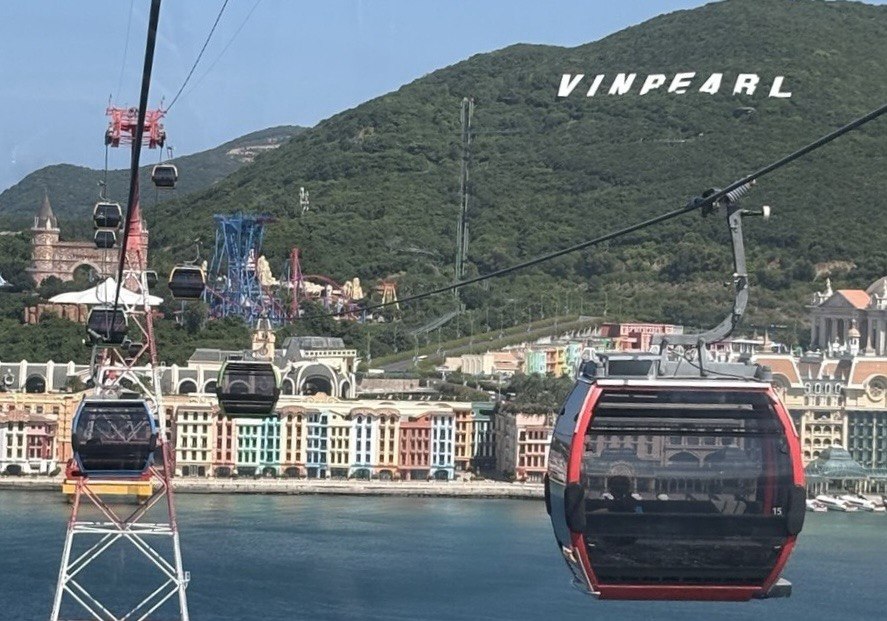
The summit allowed Vinpearl to demonstrate how corporate events can complement leisure tourism. VinWonders, with its castle, beachfront resorts, cable car across Nha Trang Bay and waterfront dining, provides delegates with an experience beyond the conference agenda.
The Tata Show, featuring about 150 Vietnamese and international performers, uses projection mapping to transform the castle into the backdrop for an original fantasy production.
The spectacle may invite comparisons with Disneyland, but the bigger business proposition is more grounded: combining accommodation, entertainment, transport and convention facilities to give international visitors more reasons to spend time and money in Nha Trang.
The challenge, as with any destination seeking a larger share of international tourism and business events, is to turn an impressive showcase into sustained visitor demand.
The summit offered a demonstration of how Vingroup hopes its businesses can reinforce one another, with technology drawing delegates, hospitality keeping them engaged, and tourism giving them a reason to come back.