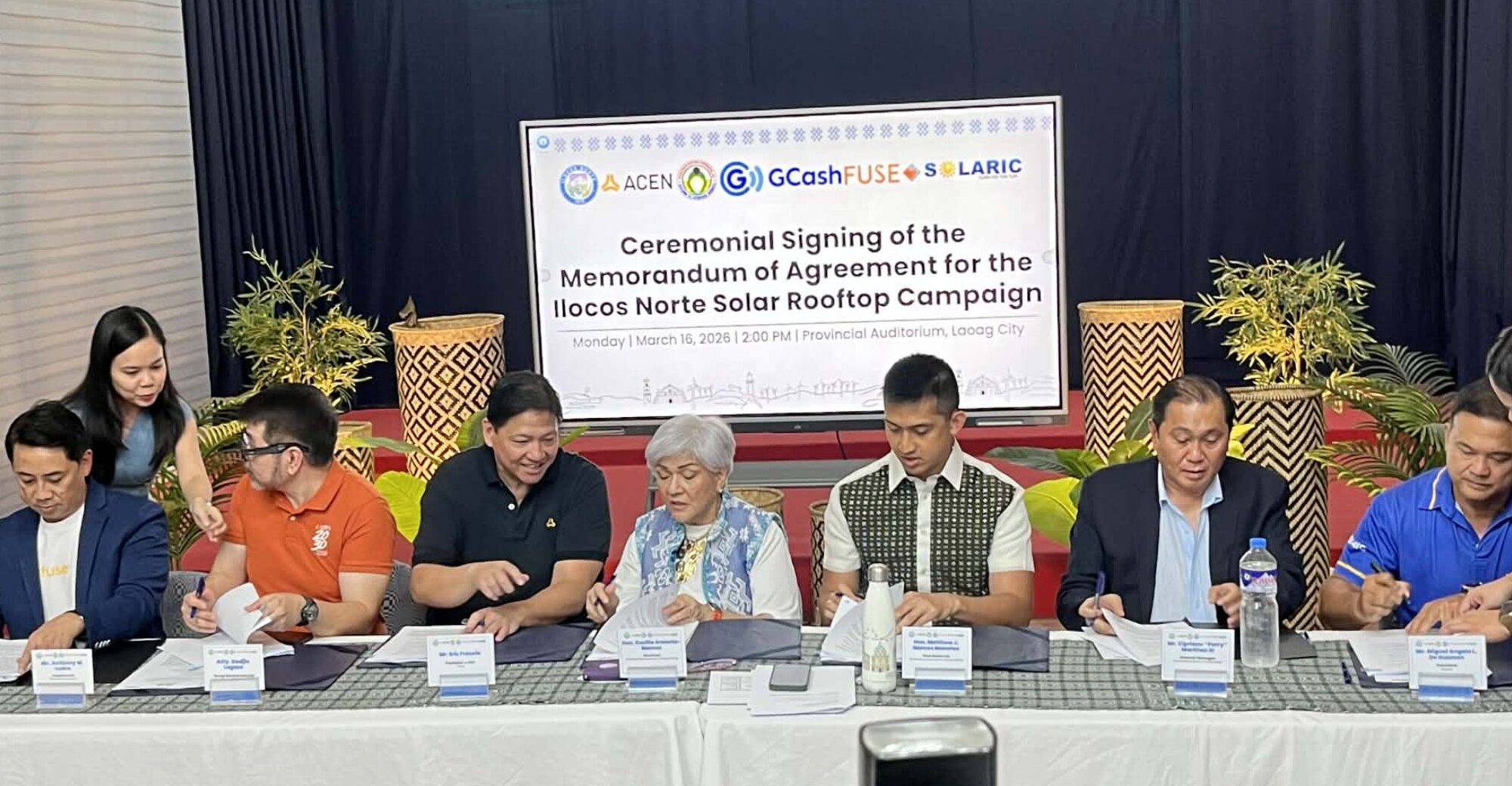
The Provincial Government of Ilocos Norte has launched a first-of-its-kind campaign to bring rooftop solar to households, partnering with ACEN and GCash to make clean energy more accessible and affordable.
The Ilocos Norte Solar Rooftop Campaign marks the country’s first local government-led effort to combine policy support, private sector financing, and energy providers into a single delivery model for residential solar adoption. The initiative also involves Solaric Philippines and Ilocos Norte Electric Cooperative to streamline installation and grid integration.
The program comes as power costs and energy security concerns rise, offering households a pathway to cut electricity bills while contributing to the country’s renewable energy transition. “By combining solar technology, accessible financing, and local engagement, we are making clean energy more inclusive,” said Eric Francia.
Unlike earlier large-scale wind and solar projects in the province, the campaign shifts focus to the household level. Residents can install rooftop systems through financing provided by Fuse Financing Inc., using the GGives platform with terms of up to 10 years and monthly payments starting at around P1,300, removing the need for traditional collateral.
The inclusion of net metering, enabled by INEC, allows households to sell excess power back to the grid in exchange for bill credits, further improving the economics of adoption.
Governor Cecilia Araneta-Marcos said the initiative reinforces the province’s position as a renewable energy leader while reducing dependence on fossil fuels. Vice Governor Matthew Marcos Manotoc added that the model could be scaled nationwide.
Beyond cost savings, the campaign highlights a shift in energy strategy, from centralized generation to distributed, consumer-driven systems. By lowering financing barriers and simplifying installation, Ilocos Norte is testing a replicable model for accelerating residential solar adoption in emerging markets.
The initial rollout will cover Laoag City, Dingras, and Pagudpud, targeting households with higher electricity consumption where savings are most immediate.