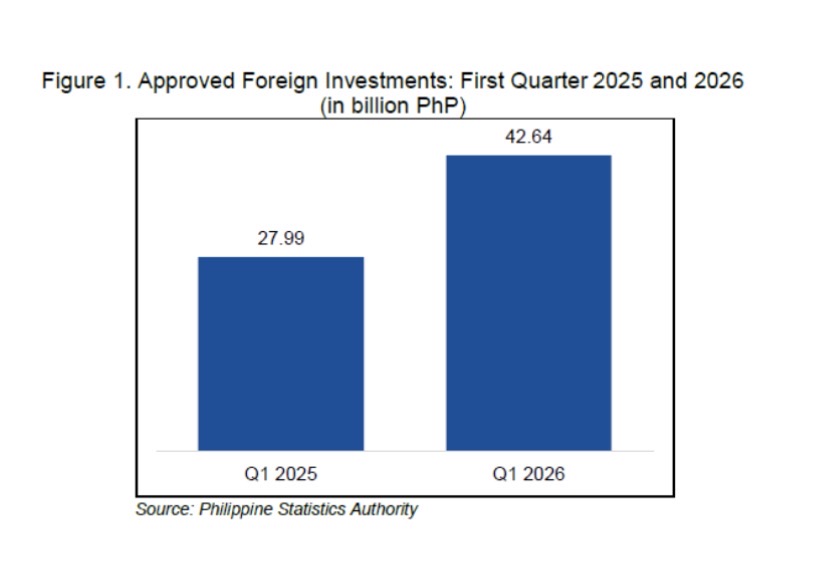
Foreign investment approvals in the Philippines jumped 52 percent in the first quarter, driven largely by South Korean capital and major projects in entertainment, manufacturing, and tourism-related industries, according to the Philippine Statistics Authority.
Data released by the PSA showed approved foreign investment pledges reached P42.64 billion from January to March, sharply higher than the P27.99 billion recorded in the same period last year.
The surge came despite a broader slowdown in total approved investments, underscoring continued foreign investor interest in select Philippine growth sectors even as global economic conditions remain uncertain.
South Korea emerged as the dominant source of investment commitments, accounting for P25.37 billion or nearly 60 percent of total foreign pledges. Singapore followed with P3.18 billion, while China contributed P2.54 billion.
By industry, arts, entertainment and recreation attracted the biggest share of foreign investments at P10.38 billion, reflecting rising investor appetite for tourism and leisure-related developments. Manufacturing followed closely with P9.08 billion, while accommodation and food service activities drew P9.07 billion.
Central Luzon remained the country’s biggest investment magnet, securing P33.08 billion or 77.6 percent of total foreign approvals, benefiting from the concentration of industrial parks, logistics hubs, and infrastructure projects in the region. CALABARZON and Metro Manila trailed behind.
Seven investment promotion agencies reported foreign investment approvals during the quarter, led by the Board of Investments and the Philippine Economic Zone Authority.
However, overall approved investments from both foreign and local investors fell 30.8 percent to P125.95 billion, signaling more cautious capital spending amid elevated interest rates, geopolitical tensions, and slowing global demand.
Electricity, gas, steam, and air-conditioning projects remained the largest investment category overall, accounting for P29.58 billion, followed by accommodation and food services and manufacturing.
The approved projects are expected to generate 21,623 jobs, down 31.9 percent from a year earlier, although projects with foreign participation are still projected to account for more than 60 percent of total employment creation.