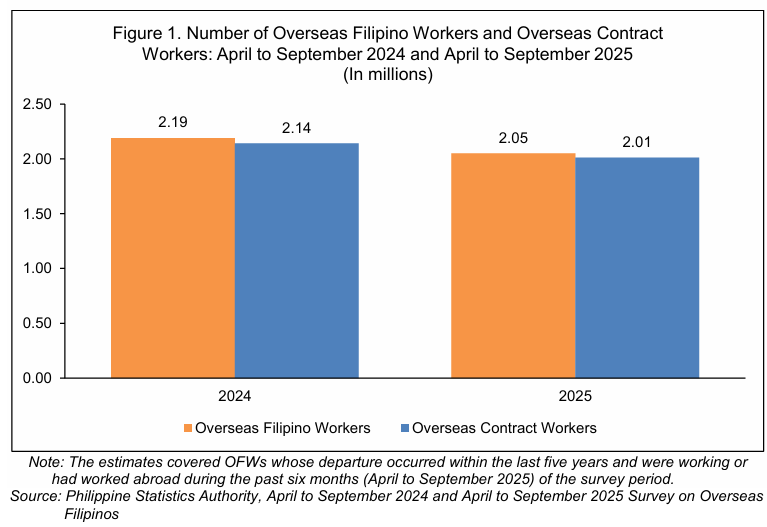
The number of Filipinos working abroad fell by 138,000 to 2.05 million in April to September 2025, with women still making up nearly six in 10 of the country’s overseas workforce, the Philippine Statistics Authority said.
The latest estimate was down from 2.19 million OFWs recorded a year earlier, marking a notable contraction in the pool of Filipinos earning a living overseas.
Overseas contract workers, or Filipinos with existing work contracts, accounted for 98 percent of the total. The remaining 2 percent were employed without work visas or permits or were working under other non-immigrant visas, including tourist, visitor, student, and medical visas.
Women numbered 1.18 million, or 58 percent of all OFWs, slightly higher than their 57 percent share a year earlier. Men accounted for about 868,000.
The overseas workforce also remained heavily concentrated in routine and lower-skilled jobs. Elementary occupations accounted for 42 percent of all OFWs, making it by far the largest occupational group. Service and sales workers followed at 16.1 percent, while plant and machine operators and assemblers made up 14 percent.
The gender divide was stark. Nearly two-thirds, or 63 percent, of female OFWs worked in elementary occupations. Among men, plant and machine operators and assemblers formed the largest group at 29 percent, followed by service and sales workers at 16 percent and craft and related trades workers at 15 percent.
CALABARZON remained the country’s biggest source of OFWs, accounting for 17 percent of the total, followed by Central Luzon at 12 percent and the National Capital Region at 9 percent.
Luzon supplied nearly six in 10 OFWs, at 60 percent, while the Visayas and Mindanao accounted for 20 percent and 20 percent, respectively.
Asia remained the overwhelming destination, receiving 74 percent of OFWs. Saudi Arabia led individual destinations at 24 percent, followed by the United Arab Emirates at 11 percent.
The numbers point to a familiar but changing picture of Philippine labor migration. Fewer Filipinos were working abroad, but those who did remained heavily concentrated in jobs that rely more on labor than specialized skills.