
The Philippine economy lost further momentum in the third quarter as higher consumer prices, declining agricultural output, and weak investment weighed on domestic activity, leaving services as the principal source of growth.
Gross domestic product (GDP) expanded by just 2.1 percent year-on-year in the July-to-September period, down from a revised 2.4 percent in the second quarter and 4 percent in the same period last year, according to the Philippine Statistics Authority. Growth for the first nine months averaged 2.5 percent.
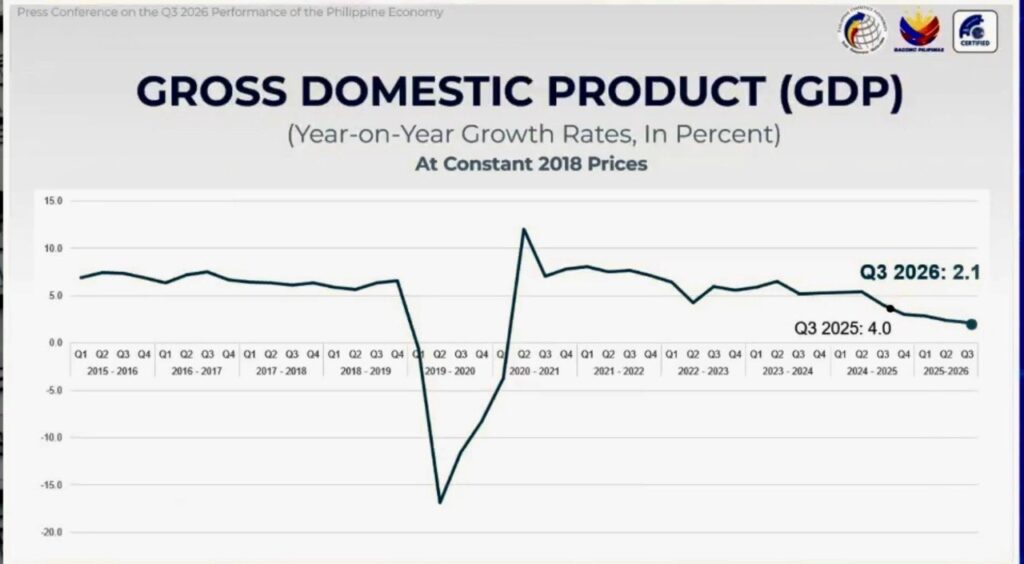
Economic Planning Secretary Arsenio Balisacan said the economy would need to grow about 6.3 percent in the fourth quarter to achieve even the lower end of the government’s 3.5-percent to 4.5-percent full-year target.
He said a recovery toward the 5-percent to 6-percent growth target for 2027 remained possible, but would require stronger investment, easing price pressures, and renewed business confidence. Energy shocks, El Niño, and project implementation delays remain key risks.
“There are also areas of strength. Exports grew by 8 percent, with electronic exports funding by 19.4 percent amid demand for AI-related products, said Balisacan. “The easing contraction in investment provides a possible starting point for recovery. Faster project implementation and lower fuel prices, if sustained and reflected in domestic costs, could support a fourth quarter pickup,” he added.
Services grew 3.7 percent, supported by wholesale and retail trade, including motor vehicle repairs, which expanded 3.54 percent. Public administration and defense grew 9.9 percent, while financial and insurance activities advanced 3.47 percent.
Agriculture, forestry and fishing contracted 4.8 percent as tropical cyclones disrupted production, with palay and corn output falling by more than 17 percent. Industry was virtually stagnant, slipping 0.003 percent.
Household consumption, traditionally the economy’s main growth engine, increased by only 2.4 percent as high food and energy prices eroded purchasing power. October inflation reached 7.8 percent, Balisacan said.
Investment also remained weak, with gross capital formation declining 0.2 percent. Public construction contracted for a sixth consecutive quarter, while investment in durable equipment fell 7.2 percent.
Exports provided some relief, expanding 8.6 percent, with electronics shipments benefiting from demand for artificial intelligence-related products.
Balisacan said faster infrastructure implementation and lower fuel prices could support a fourth-quarter pickup, but stressed the need to address investment bottlenecks and restore confidence.