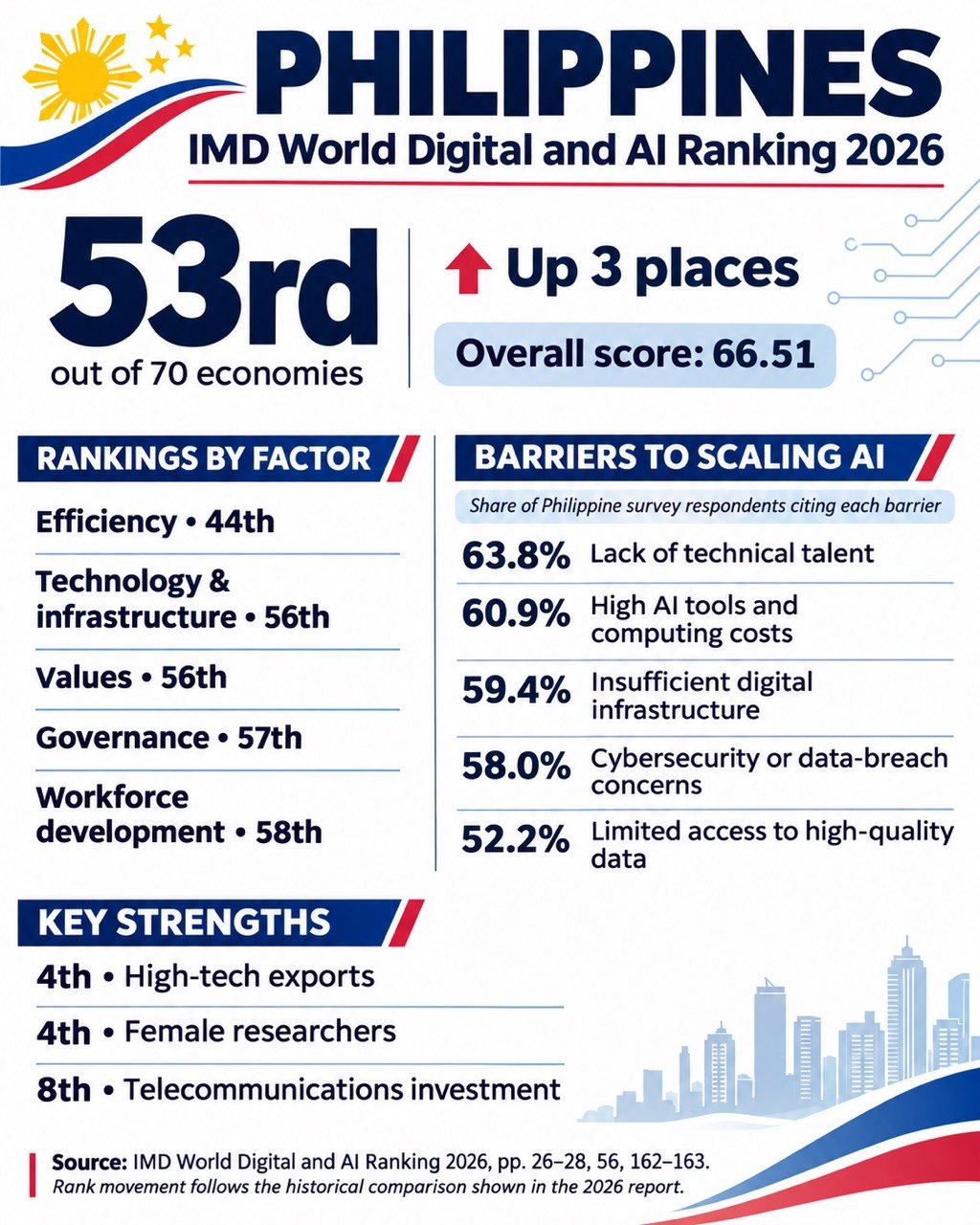
A shortage of technical talent, high AI costs, and inadequate digital infrastructure threaten to slow the Philippines’ adoption of artificial intelligence, even as the country climbed three places to 53rd among 70 economies in IMD’s 2026 World Digital and AI Ranking.
The Philippines scored 66.51, with gains in business efficiency, workforce development, and values offset by weaker performances in governance and technology infrastructure.
Efficiency was its strongest area, advancing six places to 44th. Workforce development rose four places to 58th, while values improved three places to 56th. Governance slipped to 57th and technology and infrastructure to 56th.
The gap between progress and practical readiness was evident in the survey findings. Some 63.8 percent of Philippine respondents cited a shortage of technical talent to implement and maintain AI systems, while 60.9 percent pointed to the high cost of AI tools and computing resources.
Infrastructure was another major constraint, flagged by 59.4 percent of respondents, more than twice the global average of 24.7 percent. Cybersecurity and data-breach concerns were cited by 58 percent, while 52.2 percent reported limited access to high-quality data.
The Philippines showed stronger results in select measures, ranking fourth globally in high-tech exports and female researchers. It placed eighth in telecommunications investment and 12th in flexibility and adaptability.
But these strengths coexist with weaknesses in the digital foundations needed to support broader adoption. The country ranked 66th in communications technology, 65th in internet users, and 63rd in government cybersecurity capacity.
The contrast suggests that the country’s technology-related industries and talent pool have yet to translate into equally strong digital infrastructure and institutional capacity.
IMD cautioned against drawing firm conclusions from year-on-year movements because the ranking combines established digital indicators with newer AI-specific measures for which historical data remain limited.
The three-place improvement is encouraging, but the bigger challenge is making AI accessible and useful beyond large companies and technology-intensive industries.