Fraud cost large Philippine consumer-facing companies the equivalent of 6.3 percent of their annual revenue over the past year, as scams exploiting customers’ trust emerged as the leading source of losses, according to a TransUnion study.
The figure was up from 6 percent in 2025, highlighting the growing financial burden of fraud as businesses contend with increasingly sophisticated schemes targeting consumers and digital transactions.
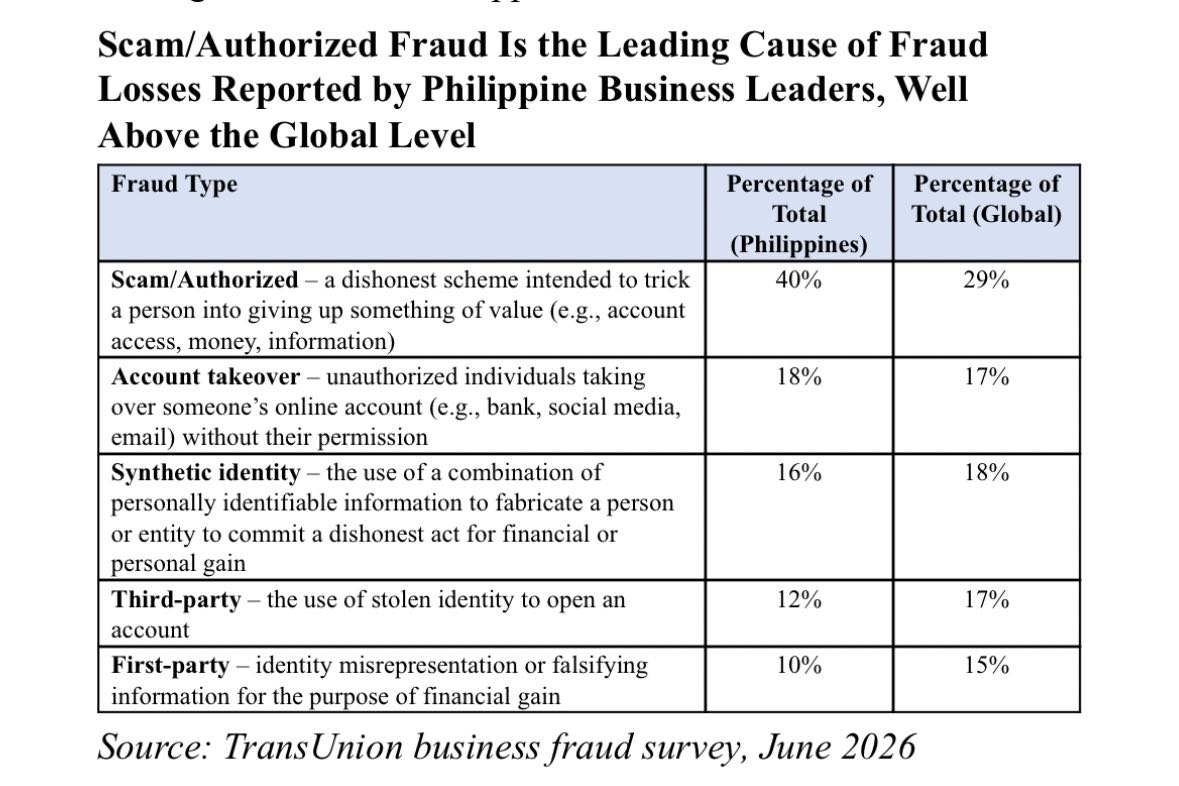
TransUnion’s Top Fraud Trends Report found that 40 percent of Philippine respondents identified scams that trick customers into voluntarily surrendering money or account details as their biggest source of fraud losses, up from 25 percent last year. This was the highest share among eight markets surveyed, against a global average of 29 percent.
Account takeovers ranked second, accounting for 18 percent of responses, followed by fraud involving fabricated identities at 16 percent.
Brand impersonation was also widespread. About 79 percent of Philippine respondents said customers had been victimized by scammers posing as their brands through text messages, while 78 percent reported email spoofing. Both figures were the highest among the markets surveyed.
“Fraudsters convince consumers to share information, credentials or money voluntarily, making these transactions appear legitimate,” said Yogesh Daware, chief commercial officer of TransUnion Philippines.
The report also found that 7.5 percent of digital transactions processed by TransUnion clients in the Philippines during the first half of 2026 were flagged as suspected fraud, compared with 4.4 percent across Asia and 2.6 percent globally.
The findings were based on a June survey of 1,600 fraud and risk decision-makers across eight markets. Philippine respondents represented companies with annual revenues exceeding P1 billion.
Looking ahead, 84 percent of Philippine respondents identified scams as among the fraud types most likely to increase over the next 12 to 24 months, while 60 percent said they felt least prepared to manage them.