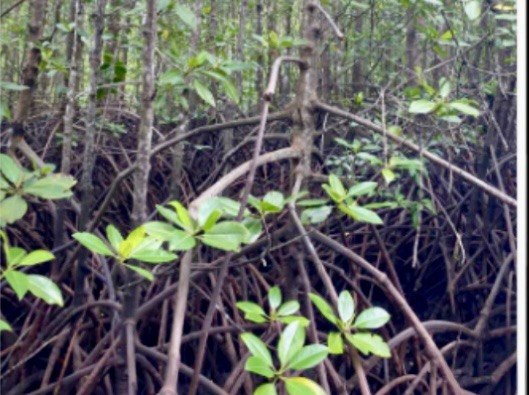
Mangroves may look like trees doing ordinary coastal work. In Dapitan City, they are doing something much bigger beneath the surface, quietly locking away millions of tons of carbon in the mud.
A study published in the Philippine Journal of Science found that mangroves in three Dapitan barangays, Oro, Baylimango, and Tag-ulo, contained an estimated 14.8 million megagrams of carbon. Most of it was not standing in trunks or branches. It was buried in sediment.
That makes the mud a climate story.
Mangrove forests are among the world’s most carbon-rich coastal ecosystems because their waterlogged, oxygen-poor soils can preserve organic carbon for long periods. The trees get the attention. The sediment does much of the heavy lifting.
Researchers Christian Jude A. Villalon and Junnasir M. Sakilan measured soil carbon through sediment coring and depth profiling, while estimating vegetation carbon using tree measurements and established allometric equations.
They recorded three dominant species, Rhizophora mucronata, Rhizophora apiculata, and Sonneratia alba. Larger S. alba trees contributed substantially to aboveground biomass, underscoring the role of tree size and forest maturity in storing carbon.
But the numbers tell the more interesting story.
The study estimated 14.02 million megagrams of carbon in sediment, compared with 768,922.68 megagrams in aboveground vegetation. In other words, the carbon vault is overwhelmingly underground.
That does not mean every ton would instantly become carbon dioxide if a mangrove were disturbed. The researchers caution that actual emissions depend on the type of disturbance, sediment exposure, and what happens to the site afterward. The estimates are better understood as indicators of carbon at risk.
There is another lesson in the geography. Oro had the highest soil carbon density, but Baylimango held the largest total carbon pool because it had more mangrove area.
Carbon density matters. So does keeping the forest in one piece.
For Dapitan, the study provides a first barangay-level blue carbon baseline that can support conservation zoning, coastal resource management, and future climate initiatives.
The takeaway is almost counterintuitive. To protect the carbon stored by mangroves, saving the trees is only half the job.
The other half is leaving the mud alone.