
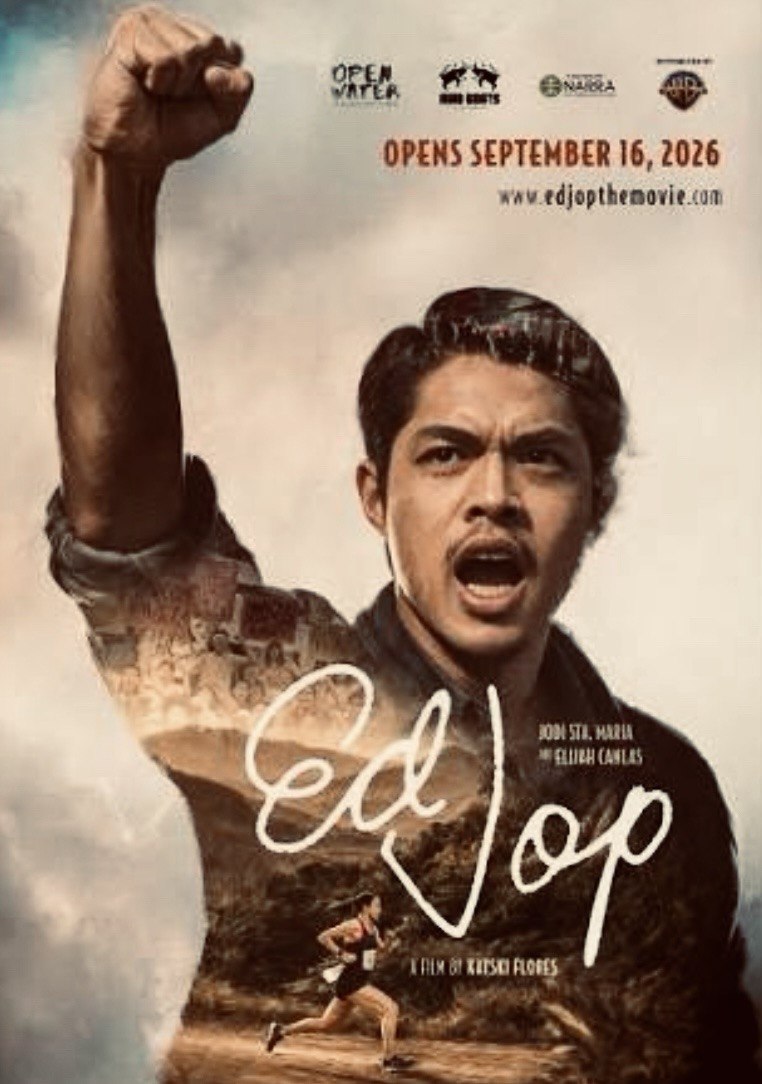
If you were to ask people what they know of Edgar Jopson, chances are they’ll mention either of these two things: Edjop the student activist who was belittled by Ferdinand Marcos Sr. for being “only the son of a grocer,” or Edjop the fallen rebel who was murdered, some say martyred, by the forces of that same despot.
Yet in Katski Flores’ film Edjop, these two instances are recounted merely as facts, not defining story arcs. The film is shown through the eyes of Joyette, Edjop’s daughter. Because she was just three when her father died, Edjop’s life and death are far removed from Joyette’s lived experience. Though beloved by many, he is a stranger to her. Someone she resents for having abandoned her.
In this five-year passion project, Elijah Canlas wears Edjop like a second skin, portraying him from his teens to adulthood with the ease that comes from having inhabited the role for all that time. As Joyette, Jodi Sta. Maria conveys complex emotions with sincerity, using the smallest gestures to deliver the biggest of blows. Even their respective breakdowns are a masterclass in control, without resorting to over-the-top histrionics.
Kakie Pangilinan (Edjop’s wife Joy) shows promise and range in her screen debut. Cedric Juan shines as Edjop’s son Noy, while stage veterans Menchu Lauchengco-Yulo (present-day Joy_ and Teroy Guzman (Edjop’s father) are equally notable. But the young Blue Eagle-turned-Isko next to me was most excited by Ron Capinding, a teacher at Ateneo High School, who was most menacing as one of Edjop’s torturers.
But the real star of this movie is its skillful storytelling.
The film intercuts between past and present, at times blurring the timelines together. In one poignant scene, Joyette roams the darkened rooms of the Jopsons’ shuttered mansion and is met by flashes of her family’s past, full of light and life. The scene ends with Edjop and Joyette seated at opposite ends of the long dining table, finally bridging his past to her present.
While employing some creative license, Flores tells Edjop’s story without exaggeration. In the screening’s talkback, she said her team attempted to stay true to the documented sources compiled during their exhaustive research.
Neil Daza’s masterful cinematography propels Flores’ truth-telling. He gifts the audience with breathtaking overhead views of jewel-toned oceans and stark, snow-covered expanses. But he also confronts them with jarringly extreme close-ups.
These shots show the actors in the most unflattering light, capturing every blemish and imperfection. The camera gets so in-your-face as to make the viewer uncomfortable, as though they were nose-to-nose with the characters. This seems a deliberate choice, meant to show the world in all its rawness. No one is perfect there. Nothing is comfortable or romanticized. What you get is the naked truth, reality laid bare.
Joyette likewise eschews judgment and offers the most intimate parts of her life to scrutiny. Her candor allows viewers to get to know her and ultimately Edjop, warts and all.
Whereas other biopics belabor all the whos, wheres and whens, Flores has been criticized for skimping on details. Nowhere is it mentioned that Edjop is an only son with many sisters. Some characters come and go unnamed. Viewers discover these things as the movie unfolds.
Rather than insulting her audience’s capacity to follow the narrative, Flores doesn’t burden them with cumbersome details. After all, it isn’t a history lesson with dates and names to be memorized. No test will follow after. It’s the story of how one life matters. It’s the age-old conflict between parent and child. It’s the story of how heroes are made.
While most heroes are depicted as unrelenting, immovable forces, Edjop’s humanity is evident. He evolves over his all-too-brief journey, beginning with peaceful protesting, then going underground, and eventually joining the armed struggle when the enemy proves to be the immovable force.
When Edjop becomes enamored with communist China, Joy chastises him, forcing him to rethink his position. He is flawed, but capable of change.
In only one way is he immovable: his unflinching belief in building a more just and humane world.
An accomplished triathlete, Joyette likens race courses to life’s journey and shares her affinity for multi-loop courses. This requires you to run the same course in laps, returning to the beginning time and again.
In a tearful exchange with her Kuya Noy, Joyette learns how much she meant to their father. How everything he did was for the sake of their family. This, along with their mother’s memories, makes her realize that what awaits her is what she’s been running from all along.
With newfound clarity, Joyette finds herself running toward the father who did not abandon her but instead fought for her. Thus, she finally sees Edjop up close. No longer a myth, a stranger, or a concept, but a fully realized man. Her father.
In the end, Edjop’s legacy is not a history lesson; it is a lesson in living.

Jasmine Ong is a development professional, accidental activist, Excel Ninja, and reformed pedant. Though a native speaker of snark, she is also fluent in long, uncomfortable silences punctuated by unpredictably timed interjections. She has a great disdain for the word pulchritude, believing that it sounds like the opposite of what it means. Her volume and impulse controls are often defective, prompting her to say, “I said that out loud, didn’t I?” at least three times a day. Convinced of an impending zombie apocalypse, she nevertheless remains a closet optimist...who just outed herself right now. D’oh.