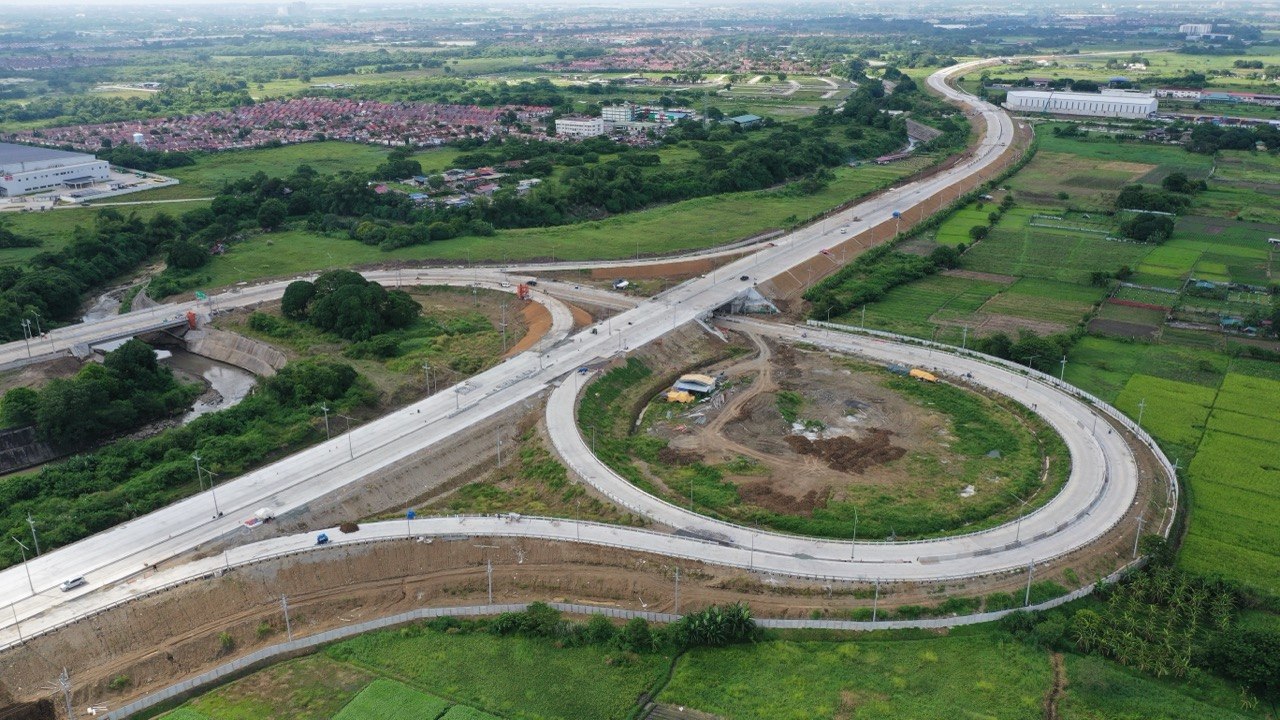
MPCALA Holdings Inc. is advancing the final stretch of the 45-kilometer Cavite-Laguna Expressway (CALAX), bringing closer a continuous transport corridor expected to ease road congestion and improve logistics links across two of Southern Luzon’s key industrial provinces.
Construction is ongoing on the remaining 18.5 kilometers, covering Subsections 1 and 2. Current works include pavement laying, bridge superstructures, drainage systems, interchange ramps and other supporting infrastructure.
CALAX presently runs from Mamplasan in Biñan, Laguna, to Governor’s Drive in General Trias, Cavite. Completion of the remaining sections will extend the four-lane expressway through Open Canal to Kawit, where it will connect with the Manila-Cavite Expressway (CAVITEX) via the CAVITEX-CALAX Link.
The resulting network is expected to give motorists and commercial operators a more direct alternative to congested local roads, improving access to industrial estates, business districts, residential communities and major economic centers.
For manufacturers and logistics providers, the expanded corridor could help streamline cargo movements between factories, warehouses, distribution hubs and consumer markets. More reliable road connections may also support workforce mobility and business expansion as economic activity spreads across Cavite and Laguna.
The benefits, however, will depend on how effectively the new links integrate with existing roads and whether traffic gains translate into more predictable travel times for businesses. An expressway can improve connectivity, but its broader economic impact also hinges on access roads, traffic management and the capacity of surrounding infrastructure.
CALAX is a public-private partnership project of the Department of Public Works and Highways, with MPCALA Holdings, a subsidiary of Metro Pacific Tollways Corp., serving as private concessionaire.
As the remaining sections progress toward completion, the project’s significance extends beyond faster journeys: it could strengthen the movement of goods across Southern Luzon and deepen links between manufacturing centers and Metro Manila’s wider market.