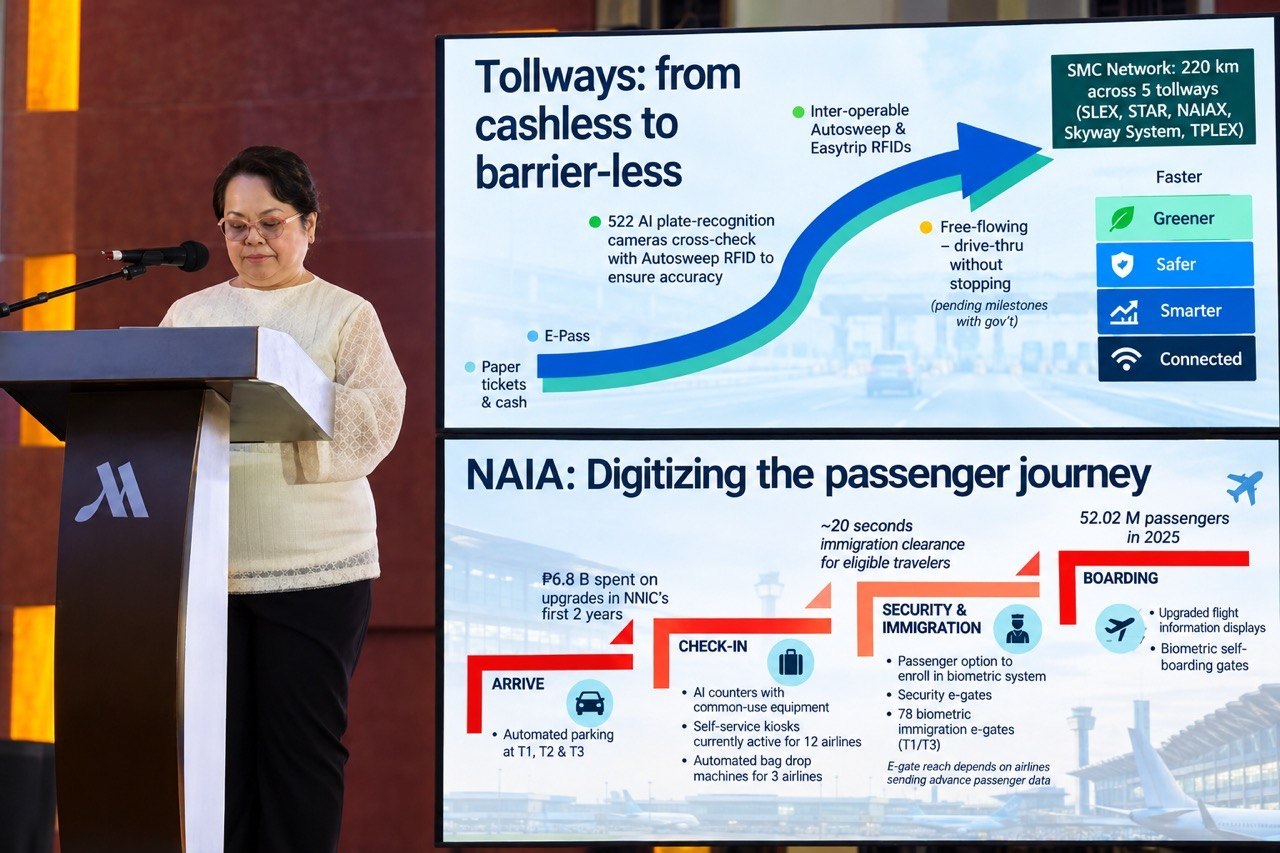
San Miguel Corp. (SMC) is expanding artificial intelligence (AI) and digital technologies across its infrastructure businesses, but regulatory requirements, low user adoption and fragmented data systems remain obstacles to full implementation.
At the Arangkada Forum, SMC Senior Vice President Rita Palabyab cited the group’s expressways and Ninoy Aquino International Airport (NAIA) as examples of how digital investments can improve efficiency while exposing gaps in implementation and industry coordination.
Across its 220-kilometer expressway network covering five tollways, SMC has deployed 522 AI-powered license plate recognition cameras alongside radio frequency identification (RFID) systems to improve toll collection accuracy.
More than five million vehicles carry RFID stickers, while interoperability between Autosweep and Easytrip has advanced efforts toward barrierless tolling. However, full implementation remains subject to regulatory requirements and milestones.
At NAIA, operator New NAIA Infrastructure Corp. has invested P6.8 billion in upgrades during its first two years, including common-use check-in equipment, self-service kiosks serving 12 airlines and automated baggage facilities.
The airport also has 78 biometric immigration e-gates capable of processing eligible passengers in approximately 20 seconds. Yet biometric enrollment remains low, while e-gate operations depend on airlines transmitting advance passenger information.
“A great system nobody uses delivers nothing,” Palabyab said, underscoring the importance of adoption in realizing the benefits of digital investments.
SMC is also modernizing enterprise data systems to support broader AI applications, including predictive maintenance and traffic forecasting.
“Skip the foundation and AI ends up making bad decisions on bad data,” Palabyab said, emphasizing the need for reliable information, regulatory cooperation and accountability.
Integrating data across systems also requires addressing confidentiality concerns, building trust and reducing bureaucratic delays.
For SMC, scaling digital innovation will depend on more than deploying new technology. Regulatory alignment, industry cooperation and sustained user participation will be critical to translating investments into faster, more efficient infrastructure services.