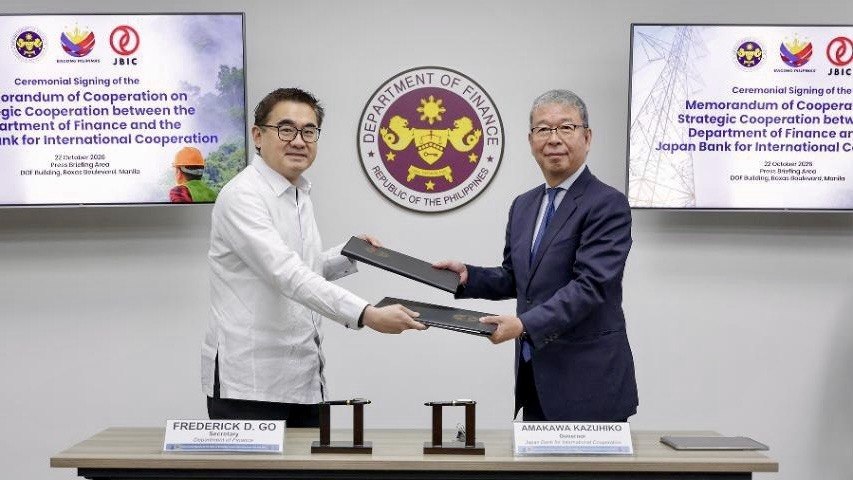
The Philippines is seeking Japanese financing and investment to reduce energy and logistics costs, with the Luzon Economic Corridor emerging as a priority under a renewed partnership between the Department of Finance (DOF) and Japan Bank for International Cooperation (JBIC).
Finance Secretary Frederick Go and JBIC Governor Kazuhiko Amakawa signed a three-year Memorandum of Cooperation (MOC) to mobilize Japanese capital and expertise for infrastructure development, clean energy and supply chain improvements.
The initiative comes as high power and transport costs weigh on business competitiveness, while the Philippines seeks to attract investment and strengthen its role in regional production networks.
“Our renewed cooperation comes at an important time. For our economy to remain competitive, we need reliable energy, efficient infrastructure, and resilient supply chains,” Go said. These, he added, are essential to managing business costs, attracting investment and sustaining growth.
A key focus is the Luzon Economic Corridor, which links Subic, Clark and Batangas. Investments in the corridor could improve cargo movement, reduce transport bottlenecks and strengthen connections among industrial centers, ports and logistics facilities.
The agreement also provides a framework for financing cooperation on public-private partnership (PPP) projects and efforts to attract additional Japanese foreign direct investment.
In energy, the two sides will explore investments supporting the Philippines’ transition to cleaner power under the Asia Zero Emission Community framework, which promotes regional cooperation toward decarbonization.
Amakawa said discussions on potential projects had already started, pointing to opportunities to turn the agreement into concrete investments.
“We view this MOC as an important first step for deeper cooperation,” he said.
However, the agreement does not specify financing amounts, firm investment commitments or project implementation schedules. Its immediate significance lies in establishing a framework for further discussions rather than guaranteeing new funding.
The impact on electricity prices, freight expenses and broader business costs will ultimately depend on which projects advance, how they are financed and how quickly infrastructure improvements are delivered.
For now, the partnership signals a push to use Japanese financing and technical expertise to address structural cost pressures, with implementation likely to determine whether the initiative delivers measurable economic gains.