



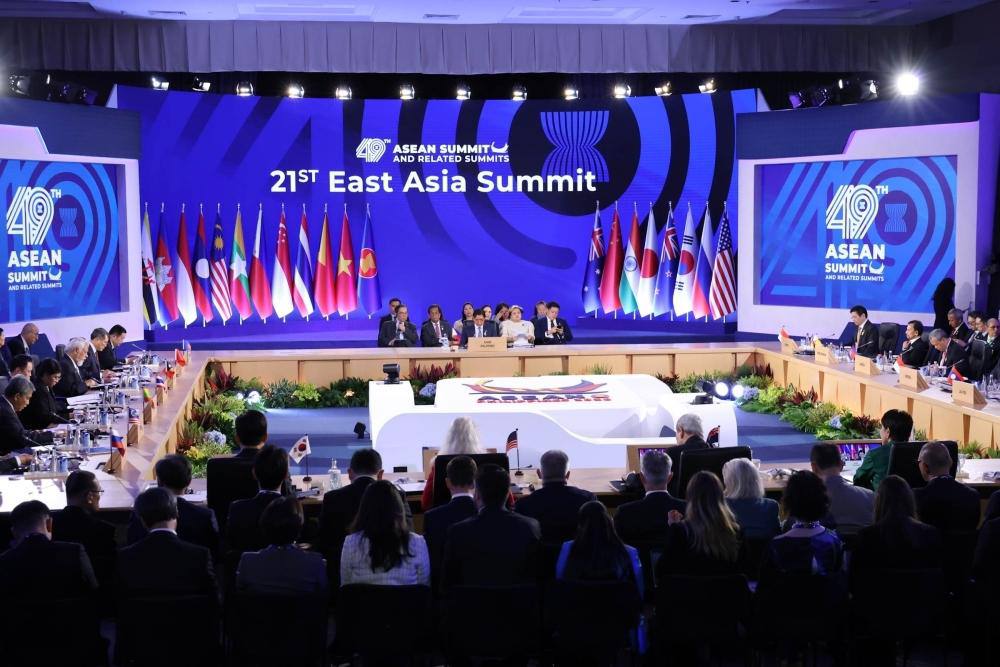
Japanese Prime Minister Takaichi at the East Asia Summit in Manila stressed the growing value of the East Asia Summit amid worsening global tensions, calling the forum a vital space for open, honest talks on key strategic regional and international issues.
The Japanese prime minister said Japan would take an active part in building an international order rooted in freedom, openness, diversity, inclusiveness and the rule of law through the updated Free and Open Indo‑Pacific framework. She identified ASEAN as central to achieving this vision, noting Japan’s strong backing for ASEAN centrality and unity, while supporting wider adoption of the ASEAN Outlook on the Indo‑Pacific, which shares core principles with the FOIP concept.
Prime Minister Takaichi also stated that any attempt to unilaterally change the status quo through force or coercion, including in the East China Sea, cannot be accepted, and reaffirmed Japan’s commitment to strengthening a free and open international order built on the rule of law and peaceful dispute settlement. She voiced serious concern over rising dangerous and coercive activities in the South China Sea that heighten regional tensions, urging relevant parties to respect the Arbitral Tribunal’s award and work toward peaceful resolution of disputes there. She also expressed strong expectations that the South China Sea Code of Conduct would follow the United Nations Convention on the Law of the Sea and safeguard the legitimate interests of all stakeholders using the waters.
The prime minister maintained Japan’s long‑standing position that peace and stability across the Taiwan Strait are critical for the whole international community. Other summit participants echoed many of these concerns, highlighting freedom of navigation and overflight, peaceful settlement of disputes under international law, and the importance of stability in the Taiwan Strait.
Leaders at the meeting also addressed North Korea, calling for its complete denuclearization and full compliance with United Nations Security Council resolutions, while raising worries over its nuclear and missile programs as well as growing military cooperation between Russia and North Korea. Delegates welcomed the adoption of this year’s East Asia Summit Leaders’ Statement on countering transnational crime, saying the outcome document would pave the way for practical, tangible regional cooperation.
Summit participants also voiced concerns over the ongoing crisis in Myanmar and expressed support for ASEAN‑led efforts to resolve the situation there. Leaders discussed instability in the Middle East, noting its impacts on global energy and food security, and stressed the need to guarantee safe, free navigation through the Straits of Hormuz. Delegates condemned Russia’s aggression against Ukraine and raised concerns over the continuing conflict, underscoring the need to work toward a peaceful resolution of the crisis.




