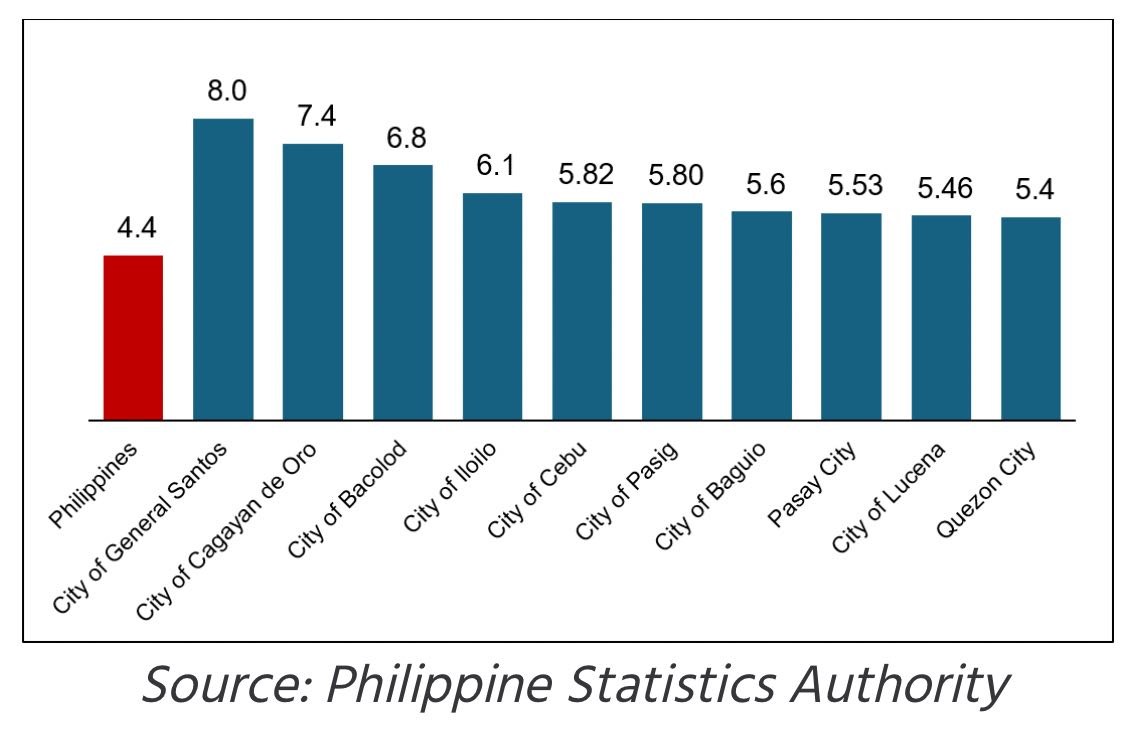
General Santos and Cagayan de Oro led the country’s highly urbanized cities (HUCs) in economic growth in 2025, putting Mindanao’s two major urban centers ahead of larger metropolitan economies in a year when all 33 HUCs posted positive growth.
The Philippine Statistics Authority (PSA) reported that 18 HUCs expanded faster than the national gross domestic product growth of 4.4 percent, indicating that economic activity extended beyond the country’s biggest urban centers.
Bacolod, Iloilo, Cebu, Pasig, Baguio, Pasay, Lucena, and Quezon City completed the top 10 fastest-growing city economies, although the PSA data also showed that rapid growth did not necessarily translate into the largest economic output.
The combined gross domestic product (GDP) of the 33 HUCs reached P10.23 trillion in 2025, equivalent to 44 percent of the national economy.
Quezon City remained the country’s largest HUC economy, with output of P1.40 trillion, followed by Makati at P1.27 trillion and Manila at P1.06 trillion. All three maintained GDP above the trillion-peso mark.
Taguig, Davao, Pasig, Parañaque, Pasay, Cebu, and Mandaluyong completed the top 10 largest urban economies.
Together, these 10 cities accounted for 30.2 percent of national GDP, underscoring the concentration of economic activity in major urban centers even as regional cities gained ground in growth rankings.
The results highlight the distinction between economic size and growth momentum. Quezon City, Makati, and Manila continued to dominate in overall output, while General Santos and Cagayan de Oro demonstrated the expanding economic weight of regional centers.
The broad-based expansion among HUCs offers a positive reading of urban economic activity, although the figures alone do not establish whether growth translated into stronger household incomes, better employment, or more evenly distributed economic gains.