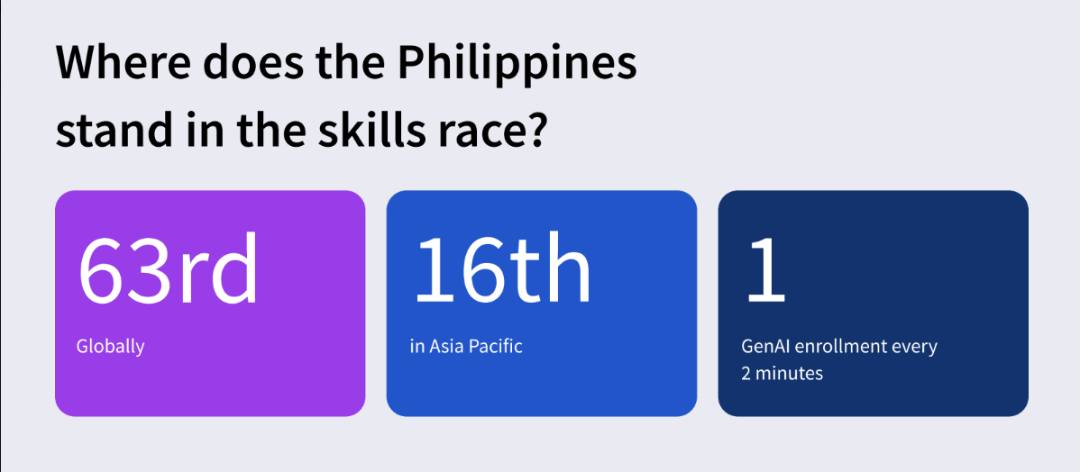
Coursera has released its eighth Global Skills Report, placing the Philippines 63rd worldwide and 16th across the Asia Pacific region in the newly launched AI-Human Skills Synergy Index. The index, the first of its kind, measures how learners in 98 countries build artificial intelligence skills alongside essential human capabilities, while also factoring in national readiness levels. It draws on learning data from over 300 million users across Coursera and Udemy, alongside insights from Oxford Insights’ Government AI Readiness Index.
Filipino learners are clearly stepping up to the AI challenge. Enrollments in AI-related micro-credentials jumped 102 percent year over year, while overall AI course sign-ups rose 91 percent – well ahead of the global average of 67 percent. Today, someone in the Philippines signs up for a generative AI course roughly every two minutes, double the pace recorded in 2025. Interest is growing fastest in specialized areas: AI security enrollments surged 567 percent, agentic workflow training rose 376 percent, and generative AI courses climbed 203 percent.
Equally important, learners are not focusing on technology alone. Enrollments in complex problem-solving courses rose 220 percent, innovation training was up 94 percent and critical thinking grew 79 percent. The data shows Filipinos are actively combining technical skills with human strengths—pairing data analytics with clear communication, and AI know-how with strategic judgment and stakeholder collaboration—to produce well-rounded, future-ready capabilities.
With one of the region’s youngest populations, the Philippines stands well-placed to build a strong talent base for an AI-powered economy. Yet the need to move fast is clear: the International Labour Organization estimates more than a quarter of all domestic jobs, or roughly 12.7 million positions, face significant exposure to generative AI, with work transformation already underway. The country’s existing framework for micro-credentials offers a solid foundation for flexible learning, but turning this youth advantage into real opportunity depends on expanding timely, practical education that builds both technical and human skills together.
“The Philippines’ strength in global services puts its workforce at the forefront of changes brought by AI,” said Ashutosh Gupta, Coursera’s Managing Director for Asia Pacific. “Its young population is a powerful advantage, but that advantage depends on preparing people for the work ahead. Investing now in specialist AI expertise and human capabilities will help young Filipinos enter the workforce with an edge and experienced professionals move into higher-value roles.”
The findings serve as a practical guide for leaders across government, industry, and education, offering a clear picture of where skills demand is rising and how to align learning pathways with the evolving needs of the Filipino workforce.