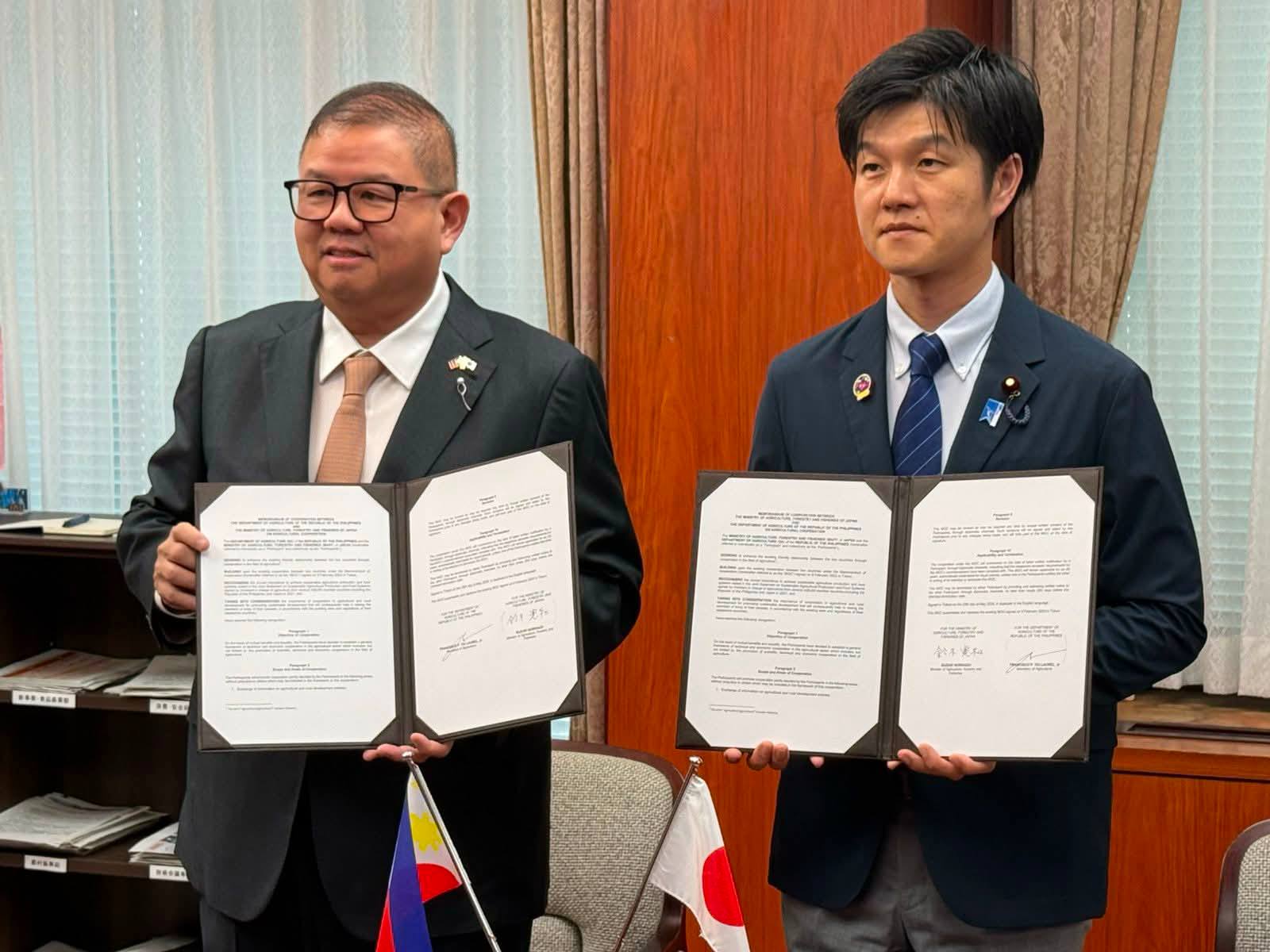
The Philippines and Japan have broadened their agricultural cooperation to include fisheries, upgrading a 2023 agreement through an enhanced Memorandum of Cooperation (MOC) signed during President Ferdinand R. Marcos Jr.’s state visit to Japan. Signed by Agriculture Secretary Francisco P. Tiu Laurel Jr. and Japanese Agriculture Minister Norikazu Suzuki, the expanded pact aims to speed up technology transfer, modernize both sectors, and strengthen food security amid climate risks, higher production costs, and rising food demand.
Cooperation now covers smart farming, digital transformation, mechanization, biotechnology, climate resilience, fisheries development, value-chain improvement, and pest control—moving beyond earlier focus on basic agricultural exchanges. Officials emphasized that food security requires resilient systems spanning both farms and fishing grounds, with innovation and modern tools as key priorities. For the Philippines, adding fisheries is especially important: the sector feeds millions and provides widespread jobs, but faces threats from resource depletion, climate change, and rising expenses.
A new Joint Committee on Agriculture and Fisheries (JCAF) will replace the old agriculture-only body, serving as the main platform for policy talks, technical projects, and joint planning. The first JCAF meeting is scheduled for July 2–3, 2026, in Tokyo. Through the deal, the Philippines gains access to Japanese expertise in precision farming, fisheries management, post-harvest handling, and food system upgrades. The agreement also marks a milestone in the 70th year of diplomatic ties between the two nations, highlighting deeper collaboration on the shared challenge of sustainable food production amid climate uncertainty.
This expansion directly supports national goals to raise productivity and protect livelihoods in two critical industries. It gives Filipino farmers and fisherfolk better access to advanced technologies and best practices, while aligning both countries on regional food security amid growing environmental and economic pressures.