The Philippines’ fast-track Green Lane program has amassed a strategic investment pipeline exceeding P6.3 trillion, underscoring strong investor appetite for large-scale energy, infrastructure, and digital economy projects—even as most ventures remain years away from full implementation.
Data from the Board of Investments’ (BOI) One-Stop Action Center for Strategic Investments (OSAC-SI) showed that 237 projects had secured Green Lane certification under Executive Order No. 18 as of May 31, 2026. Together, these projects represent P6.32 trillion (USD111.18 billion) in investments and have the potential to generate more than 420,000 jobs.
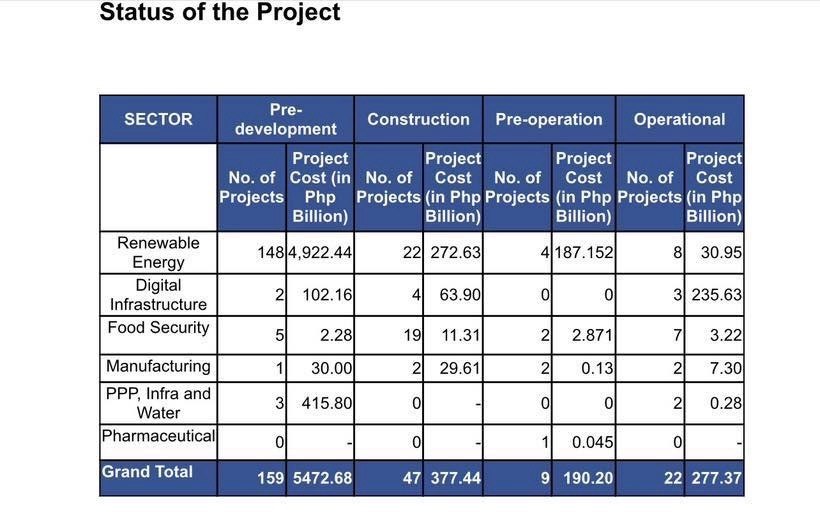
However, the numbers also reveal the long runway facing many of the country’s biggest investments. Of the total pipeline, 159 projects worth about P5.47 trillion remain in the pre-development stage, reflecting the extensive planning, permitting, financing, and construction timelines typically required for major infrastructure and energy ventures.
Renewable energy continues to dominate the Green Lane portfolio, accounting for 182 projects valued at P5.41 trillion. These projects are expected to generate more than 271,000 jobs and form the backbone of the country’s push to strengthen energy security, expand power capacity, and accelerate the transition to cleaner energy sources.
While much of the pipeline remains on the drawing board, a growing number of projects are beginning to translate into tangible economic activity. Twenty-two projects worth P277.37 billion are already operational, with digital infrastructure accounting for the largest share of completed investments.
Renewable energy and food security projects also feature prominently among operational ventures, helping expand data center capacity, improve connectivity, and boost agricultural productivity.
Another 47 projects worth P377.44 billion are currently under construction, while nine projects valued at P190.2 billion are nearing commercial operations.
The figures highlight a Green Lane program that is still largely in its build-out phase but steadily advancing toward execution. As more projects move from approvals to construction and operation, the initiative is poised to become a major driver of investment, job creation, and long-term economic growth.