The Philippines has built a P6.36-trillion investment pipeline, but the bigger challenge now is turning projects on paper into construction sites, operating facilities, and productive assets.
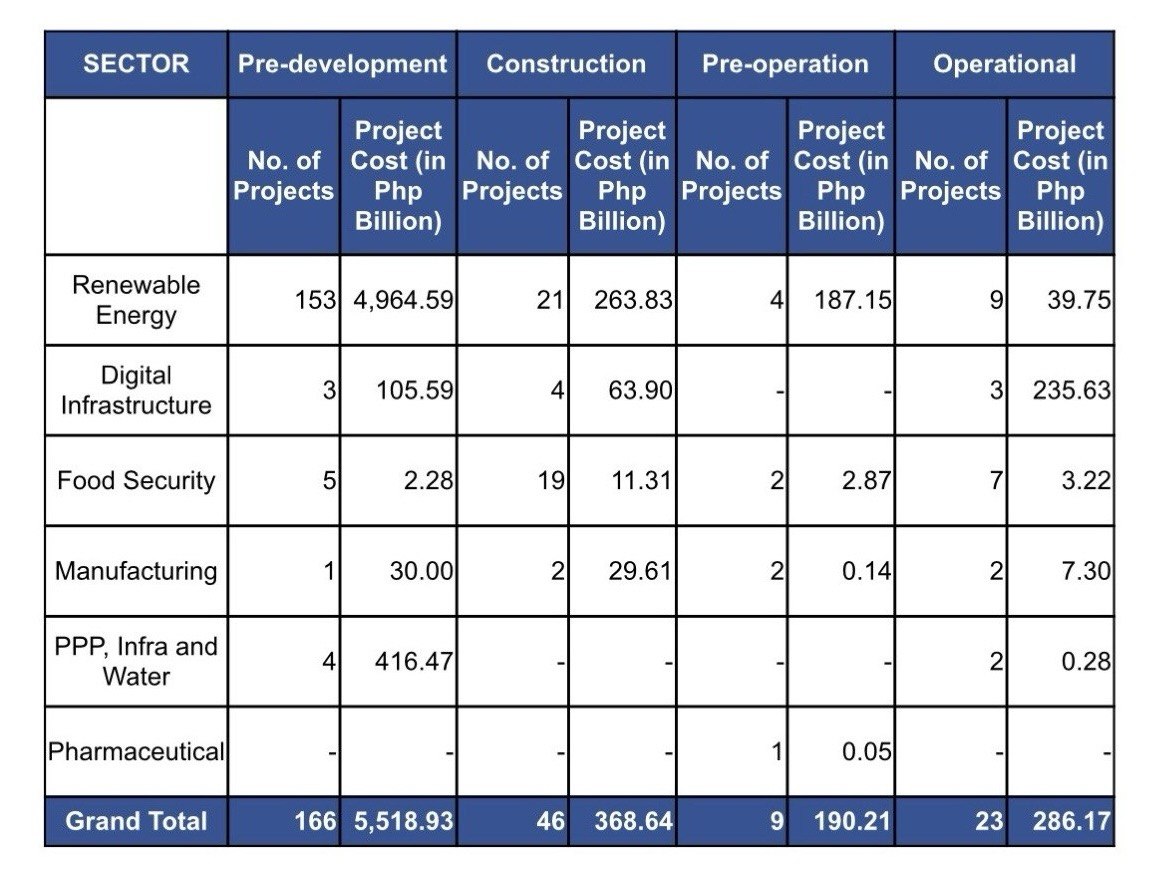
Green Lane data show that 244 projects are in the pipeline across renewable energy, digital infrastructure, food security, manufacturing, infrastructure, and pharmaceuticals.
Yet 166 projects worth P5.52 trillion remain in pre-development, accounting for nearly 87 percent of the total investment value. The numbers underscore the gap between attracting investment and getting projects off the ground.
Another 46 projects worth P368.64 billion are under construction, while nine projects valued at P190.21 billion have reached the pre-operation stage.
Only 23 projects worth P286.17 billion are operational, representing about 4.5 percent of the total pipeline by value.
Renewable energy overwhelmingly drives the pipeline, with 187 projects worth P5.46 trillion, or about 86 percent of the total investment value.
But most remain before construction. Some 153 renewable energy projects worth P4.96 trillion are still in pre-development. Another 21 projects worth P263.83 billion are under construction, while nine worth P39.75 billion are already operational.
The figures point to a familiar investment challenge. A strong project pipeline can signal investor interest, but its economic payoff depends on how quickly projects clear financing, permitting, land, technical, and other hurdles needed to reach construction.
Public-private partnership, infrastructure, and water projects form the second-largest sector by value at P416.75 billion, although nearly all of this is still at the proposal stage. Four pre-development projects account for P416.47 billion.
Digital infrastructure presents a sharper contrast. Its pipeline totals about P405.12 billion, with P235.63 billion already operational, making it the sector with the largest value of projects currently in operation.
Food security accounts for 33 projects worth P19.68 billion, while seven manufacturing projects are valued at P67.05 billion.
The pipeline therefore presents both an opportunity and a warning. The Philippines has no shortage of proposed investments. The next test is execution, converting billions in planned capital into power, factories, infrastructure, jobs, and economic activity.