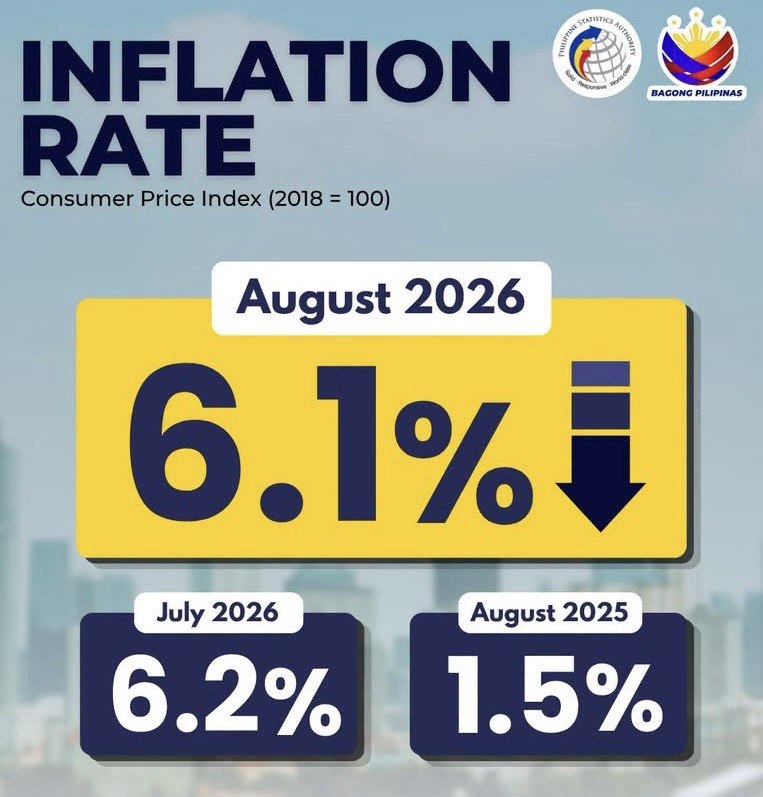
Philippine inflation eased to a five-month low of 6.1 percent in August, offering some relief after prices accelerated sharply earlier this year, but the reading remained elevated enough to underscore the Bangko Sentral ng Pilipinas’ decision to raise interest rates last week.
The Philippine Statistics Authority said headline inflation slowed from 6.2 percent in July and 7.2 percent in April. Still, August inflation remained at the upper end of the BSP’s 5.5 percent to 6.5 percent forecast for the month.
The latest reading also kept inflation well above the central bank’s 2 percent to 4 percent target range. Average inflation in the first eight months stood at 5.2 percent.
The moderation was driven largely by food, with food and non-alcoholic beverage inflation slowing to 4.6 percent from 5.2 percent in July. Housing and utilities inflation also eased to 7.9 percent from 8.2 percent.
Vegetable prices provided a particularly strong brake on food inflation, with the relevant commodity group swinging to a 3.4 percent annual decline from an 8.4 percent increase in July.
But the improvement was far from broad-based. Rice inflation accelerated to 19.4 percent from 17.1 percent, while transport inflation jumped to 13.5 percent from 11.9 percent. Fish and seafood prices remained another significant contributor to food inflation.
Core inflation, meanwhile, eased only slightly to 4.1 percent from 4.2 percent, suggesting that underlying price pressures remain sticky even as headline inflation moderates.
That backdrop helps explain the BSP’s preemptive move last week to raise its benchmark rate by 25 basis points to 5 percent, its third consecutive increase. The central bank has cited persistent inflation risks despite the recent easing in headline inflation. (Philippine News Agency)
The August result suggests monetary tightening may be starting to work at the margin, but it is too early to declare victory. Food, transport, weather-related supply disruptions, and other costs continue to pose upside risks.
For businesses and consumers, the slower August reading is welcome, but inflation remains high enough to keep purchasing power under pressure and interest rates restrictive. The challenge for the BSP is now to prevent elevated inflation from becoming entrenched without adding unnecessarily to the drag on economic activity.